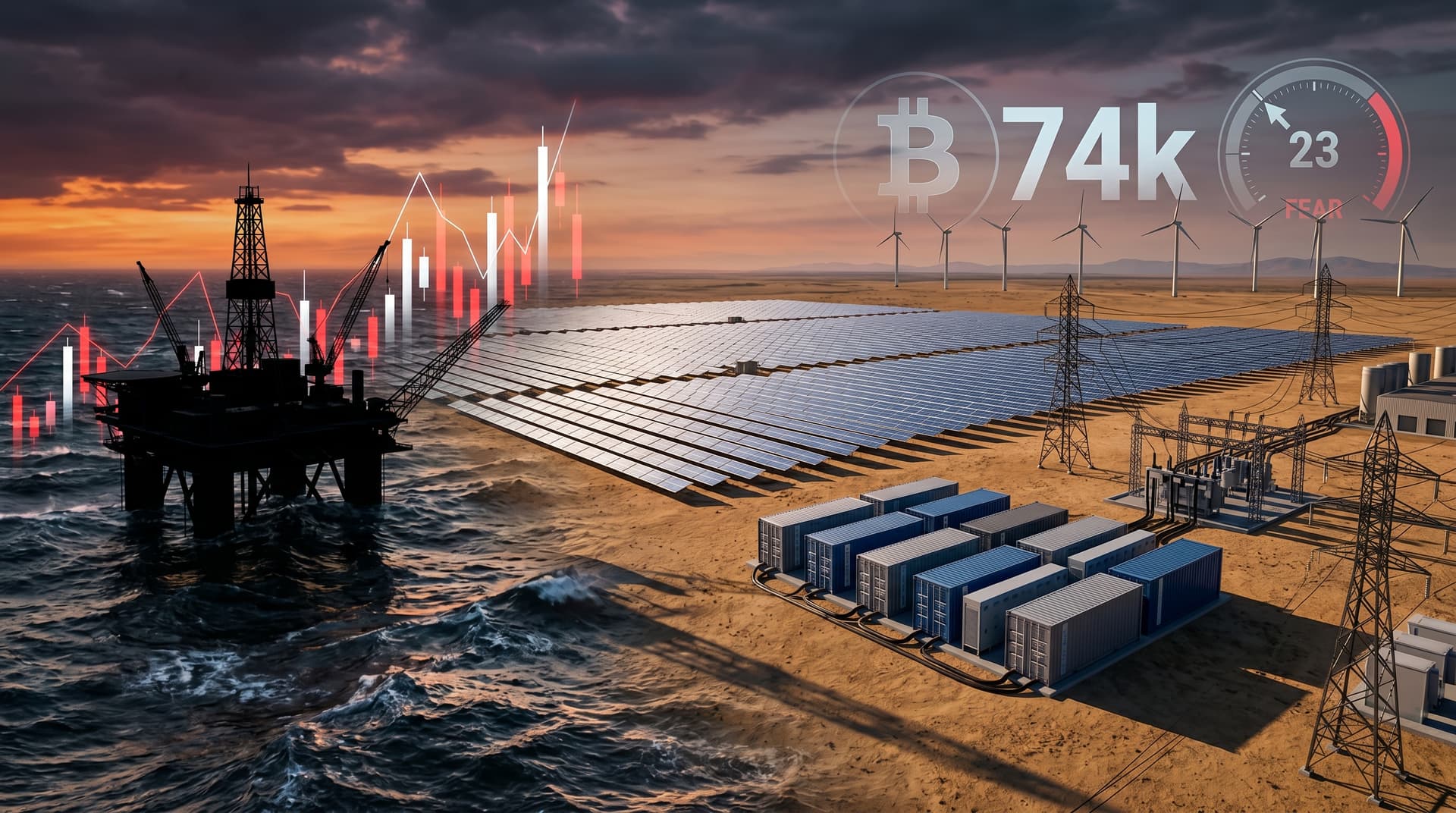
- Fear & Greed Index drops to 23 amid 10-20% oil-driven power cost surges.
- Bitcoin miners deploy 800 MWh storage like Mosaic Creek to hold $74,862 price.
- Grid batteries achieve $150/MWh LCOS with 250 Wh/kg packs hedging volatility.
Oil volatility crypto mining operations face surging power costs on April 15, 2026. Bitcoin trades at US$74,862, up 1.0% daily. The Fear & Greed Index sits at 23, signaling extreme fear. Grid storage demand accelerates to counter energy shocks.
Fear & Greed Index Signals Panic from Oil-Driven Power Strain
The Fear & Greed Index at 23 reflects investor panic, per Alternative.me data. Oil price swings link directly to natural gas volatility, states S&P Global Platts senior analyst Chris Midgley. This dynamic raises electricity costs for Bitcoin miners, who consume 121 TWh annually, according to EIA estimates from 2023.
Ethereum climbs 1.8% to US$2,362. Its proof-of-stake model cuts energy use by 99.95% versus Bitcoin's proof-of-work, notes ConsenSys CTO John Wolpert in a recent interview. XRP advances 2.5% to US$1.39. BNB rises 1.5% to US$623.87. USDT stays pegged at US$1.00.
Grid operators turn to lithium-ion batteries. These deliver 85-95% round-trip efficiency (RTE) at 1C discharge rates, per NREL's 2024 Battery Storage Handbook benchmarks. Systems offer 250 Wh/kg energy density and 4,000 cycles at 80% depth-of-discharge (DoD), tested under IEC 62660 standards.
Bitcoin Miners Chase $74,862 Price Amid Oil Market Shocks
Bitcoin miners seek power below US$0.04/kWh. Oil volatility pushes global energy tariffs up 10-20%, warns BloombergNEF lead analyst Kobad Bhavnagri in their Q1 2026 report. Utility-scale storage now displaces costly oil-peaker plants, securing stable rates.
Texas' Mosaic Creek project provides 200 MW nameplate capacity and 800 MWh storage duration. Fluence serves as EPC developer, targeting Q2 2026 commissioning, per company filings. These batteries dispatch power in under 60 seconds—five times faster than gas turbines.
Crypto firms co-locate mining rigs with solar-plus-storage hybrids. Developers target levelized cost of storage (LCOS) under US$150/MWh. This approach hedges 15-25% swings in fossil fuel prices, according to Wood Mackenzie modeling from their Global Energy Storage Market report.
Grid Storage Tactics Mitigate Oil Volatility Crypto Risks
Lithium-ion packs support energy arbitrage. Operators store off-peak power at US$20/MWh, then discharge for peak-time mining. Flow batteries from ESS Inc. offer 10-hour duration at 50-70% RTE and 10,000 cycles to 80% capacity retention.
FERC Order 2222 requires distributed energy resource integration, issued in 2020. ERCOT forecasts 5 GW storage additions by 2027, per their 2026 Long-Term System Assessment. Miners secure firm offtake through 4-hour lithium-ion systems at 250 Wh/kg and US$132/kWh pack costs.
Sodium-ion batteries aim for US$100/kWh with 6,000 cycles at 160 Wh/kg, announces CATL CEO Robin Zeng at their 2026 Battery Day event. Iron-air technology from Form Energy hits 100-hour duration at US$20/kWh LCOS in pilots, with commercial scale by 2028.
Supply Chain Shifts Strengthen Storage Against Geopolitical Risks
The Inflation Reduction Act (IRA) tax credits drive 50 GW U.S. deployments by 2030, forecasts Wood Mackenzie principal advisor Ryan Castilloux. EU's REPowerEU plan mandates 100 GW storage capacity by 2030. APAC leads with 200 GWh annual lithium sourcing, dominated by Australia and Chile mines.
Cathode prices for NMC materials drop 80% to US$15/kg since 2022, reports Benchmark Mineral Intelligence director Simon Moores. Pack-level costs reach US$132/kWh at gigafactory scale, per Adamas Intelligence data. This enables LCOS parity with peaker plants.
Trade tensions add risks. U.S. tariffs on Chinese cells rise to 25%, per Section 301 updates. Domestic production ramps via IRA incentives, targeting 100 GWh/year by 2028.
Oil volatility hastens grid modernization. Lithium-ion dominates commercial deployments at 90% RTE. Long-duration tech like iron-air fills 100-hour gaps. Crypto miners build resilience via 800 MWh projects such as Mosaic Creek.
The next EIA report on April 22 will detail power demand shifts. Bitcoin tests US$74,862 support levels. Storage investments shield operations against ongoing energy shocks from oil volatility crypto dynamics.
This article was generated with AI assistance and reviewed by automated editorial systems.