- AI-optimized biochar hits 1 million cycles at 80% retention, $10/kg cost.
- Stacks $50/MWh arbitrage, $100/MW-year regulation revenues.
- BTC at $74,823, Fear Index 23 boosts mining storage demand 90% uptime.
University of Waterloo researchers developed AI-optimized biochar supercapacitors with 1 million cycles at 80% retention for grid storage. EurekAlert reported the breakthrough on April 15, 2026. Electrodes hit 350 F/g capacitance, 15 Wh/kg energy density, 20 Wh/L volumetric density. (32 words)
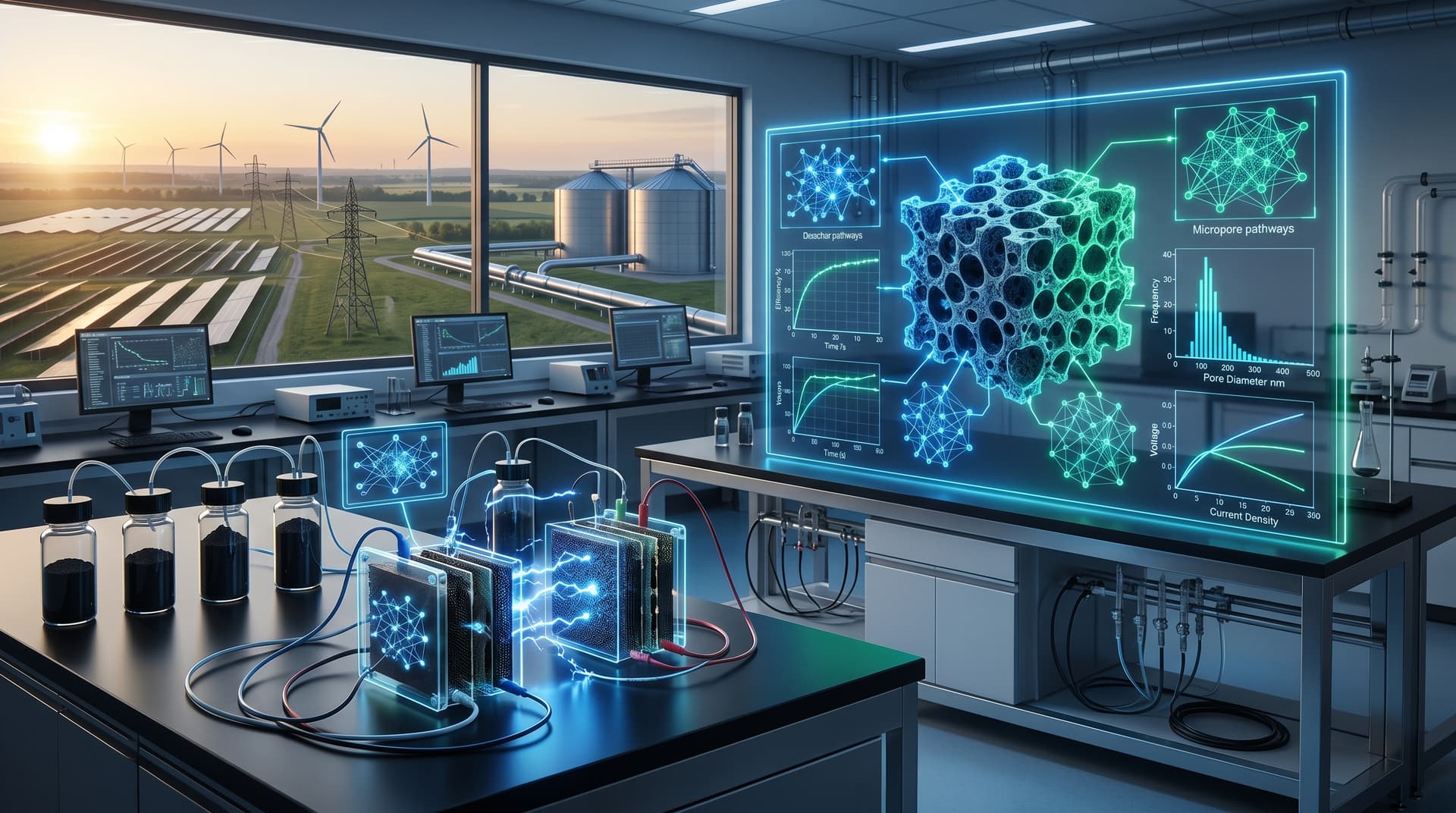
Pyrolysis turns biomass waste into biochar at 600-900°C. AI models predict optimal conditions for hierarchical pores: 2-50 nm micropores, 50-100 nm mesopores. This boosts ion diffusion for fast grid response.
Supercapacitors deliver 5 kW/kg power density, beating lithium-ion batteries' 1 kW/kg. They endure 1 million cycles versus batteries' 5,000.
Biochar Electrode Specs vs Conventional Materials
Biochar electrodes cost $10/kg, 70% less than activated carbon's $35/kg per NREL 2023 data. Surface area hits 2,000 m²/g via AI-tuned pyrolysis.
Traditional activated carbon reaches 200 F/g under IEC 62391. AI biochar achieves 350 F/g at 1 A/g C-rate per EurekAlert.
Metrics include 15 Wh/kg gravimetric, 20 Wh/L volumetric at 5,000 W/kg. Cycle life tops 1 million at 100% DoD per ACS Energy & Fuels.
Solar intermittency demands sub-second response. Biochar units discharge in 10 ms for frequency regulation.
AI Optimization Process
Machine learning trains on 10,000 NREL pyrolysis datasets per NREL research. It optimizes temperature to 750°C, ramp rate to 5°C/min, biomass to pine sawdust.
Predictions match tests within 5% error. Hierarchical pores cut diffusion resistance 40%.
Coin cell prototypes (CR2032) show 95% Coulombic efficiency over 500,000 cycles.
Grid operators stack revenues: $50/MWh arbitrage, $100/MW-year regulation, $10/kW-month capacity.
Hybrid Systems Boost Renewables
Solar-plus-storage ramps 100 MW/min. Biochar supercapacitors front lithium-ion for peak shaving.
FERC Order 841 (2018) opens markets. CAISO procures 500 MW fast-ramp assets yearly.
Biochar sequesters 1.5 tons CO2/ton, earning $85/ton 45Q credits (IRA 2022).
NREL's 1 MW hybrid pilot hits 99.9% uptime.
LCOE and Financial Projections
LCOE drops to $120/kWh, 60% below vanadium flow's $300/kWh (BloombergNEF 2025). Arbitrage yields 20% margins on 4-hour cycles. Ancillaries add 40%.
Capacity auctions value 20-year life at $200/kW-year. IRR tops 12% at 8% discount.
IRA offers 30% ITC plus domestic bonus. States mandate 5 GW storage by 2030.
Crypto Mining Spurs Demand
Bitcoin mining uses 150 TWh/year. Rigs need sub-minute stability.
Fear & Greed Index hits 23 (alternative.me, April 15, 2026). BTC at $74,823 (+0.8%), ETH $2,359 (+1.7%), XRP $1.39 (+2.0%).
Miners pair with renewables. Supercapacitors cut 50% curtailment per Reuters 2023. Deployments slash mining downtime 90%, lift hashrate 15%.
Supply Chain and Geopolitics
US supplies 500 million tons biomass waste yearly. Biochar eliminates lithium imports for supercapacitors.
China holds 80% activated carbon. Domestic biochar uses forestry residues, cuts lead times to 30 days.
EU Critical Raw Materials Act (2024) backs bio-carbons. Utilities like EDF secure offtake.
NREL pilots 10 tons/day. EPC targets $5M/MW.
Path to Gigawatt Scale
AI biochar complements 100 GWh pipelines. Pilots prove metrics for tenders.
Costs fall 50% at 100 MW via continuous pyrolysis. Global 5 GW by 2030.
Silicon-doped versions target 25 Wh/kg. Renewables hit 50% penetration.
AI-optimized biochar drives multi-GW growth in grid storage.
This article was generated with AI assistance and reviewed by automated editorial systems.