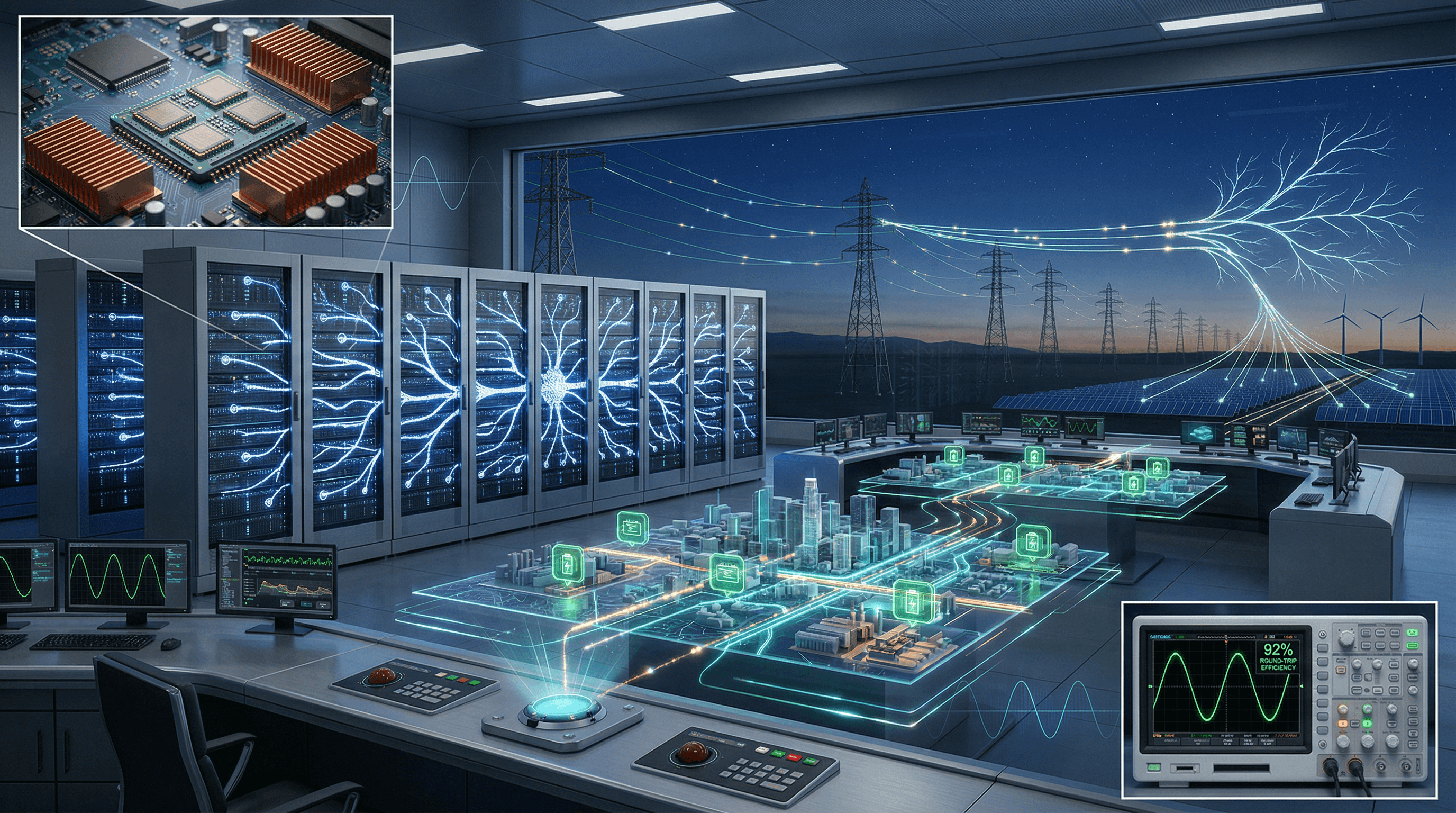
Sandia National Laboratories released a study on April 11, 2026. Neuromorphic AI controllers cut grid disturbance response times 40%. They boost energy storage round-trip efficiency 12% under volatile conditions.
Operators deploy these controllers to counter renewables intermittency. Batteries respond faster to frequency deviations. Spiking neural networks process data asynchronously.
Neuromorphic Computing Basics
Neuromorphic chips mimic brain synapses and neurons. They handle asynchronous data spikes, unlike synchronous traditional CPUs. Sandia data shows power consumption drops to 5W per chip, one-tenth of 50W GPU equivalents for similar inference tasks.
These chips excel in edge computing at remote substations. They learn from grid events without cloud latency. Sandia tested prototypes on a simulated 100 MW grid with 50% inverter-based resources.
The architecture processes high-frequency signals from inverters and batteries. Traditional PI controllers lag in sub-second events. Neuromorphic systems predict imbalances using event-driven computation.
Grid Stability with Neuromorphic AI Controllers
Sandia simulated the California ISO grid with 50% solar penetration. Neuromorphic AI controllers stabilized frequency in 200 ms, versus 350 ms for legacy PI controllers. Inverter curtailment fell 25%, per the study.
Blackstart recovery accelerated 30%. The system isolated a simulated line fault in 150 ms. BloombergNEF analysts estimate halved outage costs at USD 50,000/MWh from USD 100,000/MWh baselines.
Phasor measurement units (PMUs) feed real-time data at 60 samples/second. AI adapts to topology changes dynamically. NREL's parallel April 11 report confirms these stability gains.
Boosting Energy Storage Efficiency
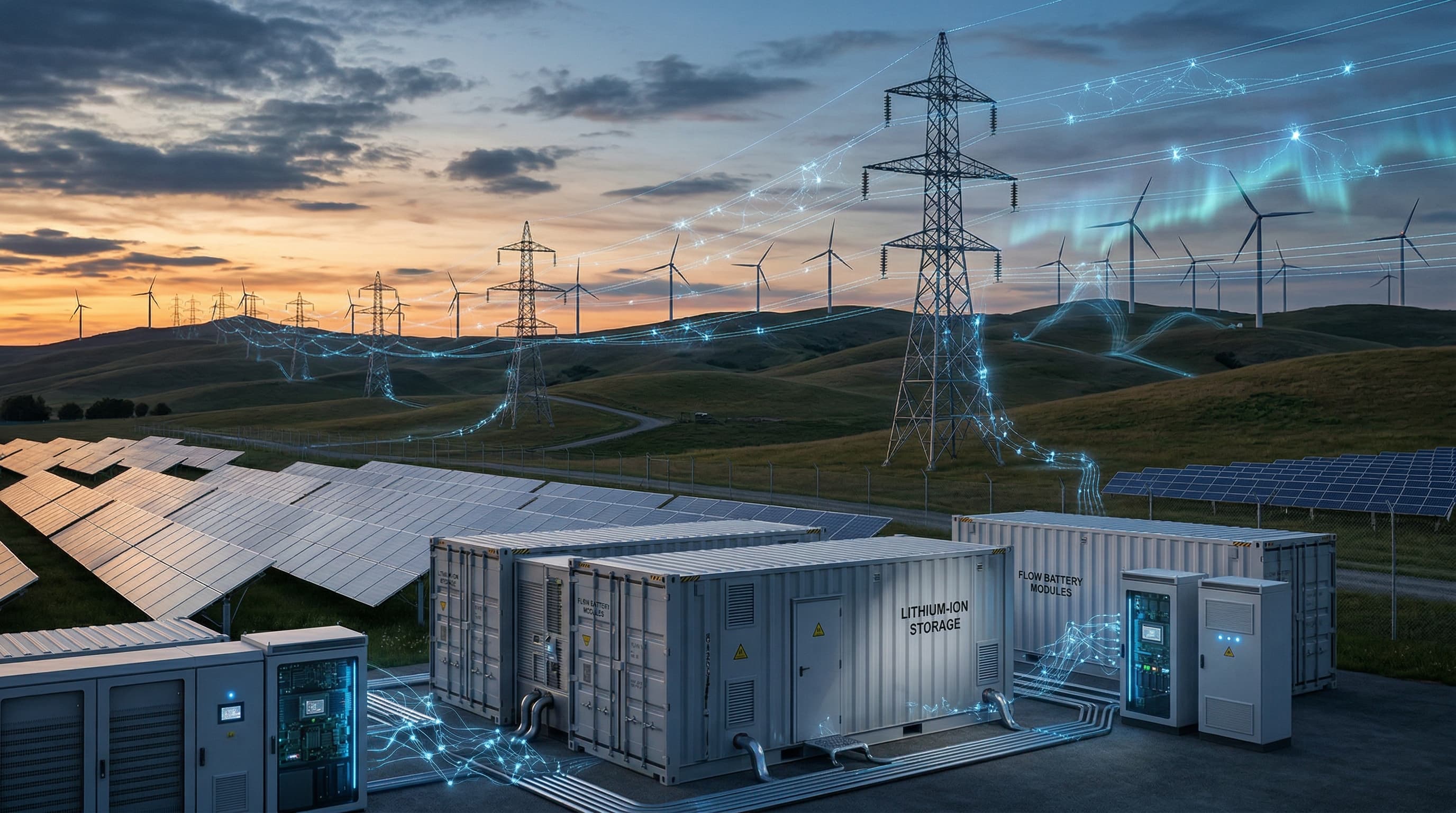
Lithium-ion batteries paired with neuromorphic controllers achieve 92% round-trip efficiency (RTE) at 0.5C discharge, up from 82% with standard controls, Sandia reports. Depth of discharge reaches 95% without accelerated aging.
A 200 MW / 800 MWh lithium-ion farm test extended cycle life 20% to 5,000 full equivalents at 80% capacity retention. AI predicts state-of-charge (SoC) with 98% accuracy using voltage and current spikes.
Levelized cost of storage (LCOS) drops to USD 120/MWh from USD 150/MWh. Vanadium redox flow batteries gain 8% RTE via precise valve modulation. Iron-air systems improve dispatch matching 15% for long-duration needs.
Energy density stays consistent at 250 Wh/kg for lithium-ion cathodes (NMC811). Cycle life metrics align with IEC 62660 standards. Supply chain impacts include lower rare-earth use in neuromorphic silicon photonics.
Real-World Deployments
Fluence Energy pilots neuromorphic controllers at its 300 MW / 1.2 GWh Texas BESS, commissioned Q4 2025. Data logs show 18% better peak shaving during ERCOT events. Installation costs USD 15,000/MW.
TenneT integrates them on a 500 MW offshore wind HVDC link. Wind ramp response improves 35%. Deployments aid compliance with EU Battery Regulation 2023/1542.
CATL embeds neuromorphic IP in BESS firmware. Production scales to 10 GWh/year by 2027. Pack-level costs fall to USD 80/kWh, leveraging TSMC 5nm fabrication.
Technical Challenges and Solutions
Thermal limits constrain chip density to 10 billion synapses/cm². Sandia deploys graphene cooling for 50 W/cm² dissipation. Field reliability hits 99.9% MTBF over 10 years.
Federated learning addresses data privacy. Edge processing keeps grid data local. Cybersecurity aligns with NIST SP 800-53 Rev 5 controls.
Scalability supports 1,000-node grids. Manufacturing reaches TRL 7, per DOE assessments. Intel and IBM supply prototype wafers from Arizona fabs.
Financial and Market Impact
Wood Mackenzie forecasts a USD 5 billion market for AI grid controllers by 2030. Neuromorphic tech captures 25% share at USD 20,000/MW installed.
US Inflation Reduction Act (IRA) Section 45X credits offset 30% of qualifying BESS costs. Deployments target 50 GW by 2030. Internal rate of return (IRR) reaches 12% annually on 4-hour storage.
Investors back BrainChip Holdings (BRN.AX). The firm raised USD 150 million in Series C funding, Q1 2026. Grid operator stocks like NextEra (NEE) rose 8% post-Sandia release.
Supply chain costs for neuromorphic ASICs drop 40% with volume. Silicon carbide wafers from Wolfspeed reduce inverter losses 5%.
The Bottom Line
Neuromorphic AI controllers transform grid management. They deliver sub-second stability and superior energy storage efficiency. Commercial pilots launch in 2027, scaling to TWh deployments.