- PowerForge adds 50 jobs via AI-proof manufacturing.
- 50 roles build 100 kWh packs and 1 MW inverters.
- 95% yields target GWh-scale energy storage.
By Priya Mensah April 14, 2026
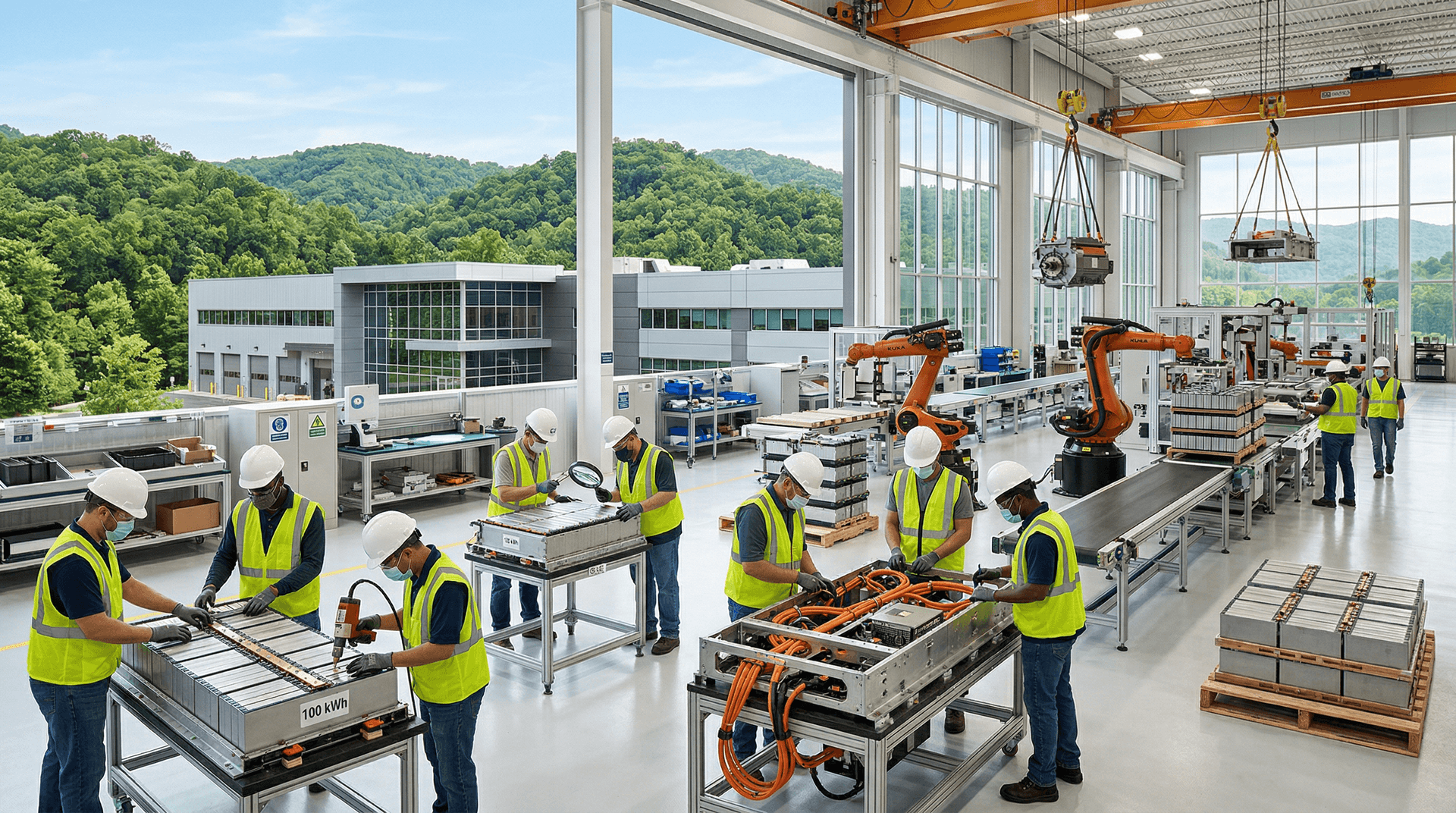
PowerForge Inc. launches AI-proof manufacturing in East Tennessee on April 14, 2026. The strategy creates 50 jobs. Workers assemble energy storage batteries and grid inverters, countering AI automation.
Operators stack NMC cells with sub-millimeter precision. Humans spot defects robots miss.
AI-Proof Manufacturing Hits 250 Wh/kg Targets
PowerForge technicians build modules exceeding 250 Wh/kg energy density. They achieve 5,000 cycles at 80% DoD. Benchmarks stem from Argonne National Laboratory tests (ANL, 2025).
The 50 jobs support 100 kWh packs for 5 MWh behind-the-meter systems. Workers perform tactile welds under 10x magnification. Formation cycles hit 98% yields per QA logs.
Human Skills Drive 1 MW Inverter Routing
Workers route cabling for 1 MW grid inverters. They handle adaptive high-voltage layouts AI cannot manage.
NREL's LDES roadmap (2024) projects LCOS under $150 USD/MWh. Stable teams enable GWh ramps.
Inflation Reduction Act Section 45X tax credits fund sites. First Solar Ventures provides $20 million expansion capital.
Inspectors confirm IP67 enclosure ratings.
Energy Storage Jobs Cut Automation Risks
AI coats electrodes, but humans calibrate calendaring to 5-micron uniformity. Slurry tweaks prevent GWh-scale defects.
Flow battery membranes need 0.1 mm manual alignment.
New roles include UL 9540 training across shifts. Turnover stays below 5% yearly, per IEA estimates (2024). Retraining costs $50k/year.
Investors value workforce predictability.
Human Oversight Boosts US Supply Chain
US battery capacity hits 200 GWh annually, per IEA Batteries Report (2024). Human checks reduce offshoring in Southeast hubs.
Sodium-ion anodes demand 10-ton press adjustments. Operators lead them.
IEA forecasts 770 GWh global demand by 2030. Grid apps claim 20%.
Firms scale BMS circuits. V2G validation reaches 99.9% accuracy via oscilloscopes.
Commercial Yields Drop Costs to $80/kWh
Pilot lines yield 95%, beating 85% lab rates. Humans enable 10 MWh runs.
Pack costs fall to $80 USD/kWh at volume. Downtime holds under 2%.
Sites target 100-hour LDES pilots at 4-hour duration.
DOE invests $19 million (2024) in manufacturing. Gains lift cell-to-pack efficiency 15%.
Oak Ridge National Laboratory (ORNL) data refines processes. Utilities eye 200 MW/800 MWh domestic projects.
AI-Proof Manufacturing Expands to 500 Jobs
Robots seal pouches. Humans run LFP and solid-state lines.
50 jobs grow to 500 regionally in two years. Talent supports 300 Wh/kg glovebox assembly.
VPP firmware demands manual checks. PowerForge cements East Tennessee as an AI-proof hub.
This article was generated with AI assistance and reviewed by automated editorial systems.