Energy Storage News, April 10, 2026
By Emma Richardson
Sandia National Laboratories unveiled brain-like AI controllers mimicking human brain neurons to optimize grid storage stability and efficiency. EurekAlert reported the findings on April 10, 2026.
Sandia simulations tested brain-like AI controllers on a 500 MW grid model with 200 MWh lithium-ion storage. The system delivered 40% faster frequency regulation than traditional proportional-integral-derivative (PID) controllers, per Sandia data. Utilities now dispatch batteries precisely during peaks.
Brain-Like AI Mimics Brain Efficiency
Neuromorphic chips process data via spikes, like brain synapses. Sandia engineers deployed Intel's Loihi 2 neuromorphic processor for the controllers. This setup handles grid disturbances in microseconds.
Traditional controllers rely on centralized computing with latencies over 100 ms. Brain-like AI reduces latency to 2 ms, Sandia simulations confirm. Storage batteries respond instantly to voltage fluctuations.
The technology targets frequency nadir events below 59.5 Hz. Tests restored balance 35% quicker, Sandia data shows. BloombergNEF reports grid-scale storage reached 150 GW globally in 2025.
Integration with Battery Storage Systems
Controllers direct lithium-ion and flow batteries in utility-scale projects. A 100 MW/400 MWh facility simulation showed 15% better state-of-charge management, per Sandia data. This reduces depth-of-discharge cycles.
Over 5,000 cycles, degradation dropped 20% versus baseline controls. Iron-air long-duration storage benefits most from adaptive algorithms. The AI predicts renewable intermittency from solar and wind inputs.
Wood Mackenzie forecasts grid AI markets at USD 12 billion by 2030. NextEra Energy tests the tech in 300 MW Florida projects. Controlled storage costs fall to USD 120/kWh from USD 160/kWh, Wood Mac estimates.
Performance Data from Grid Simulations
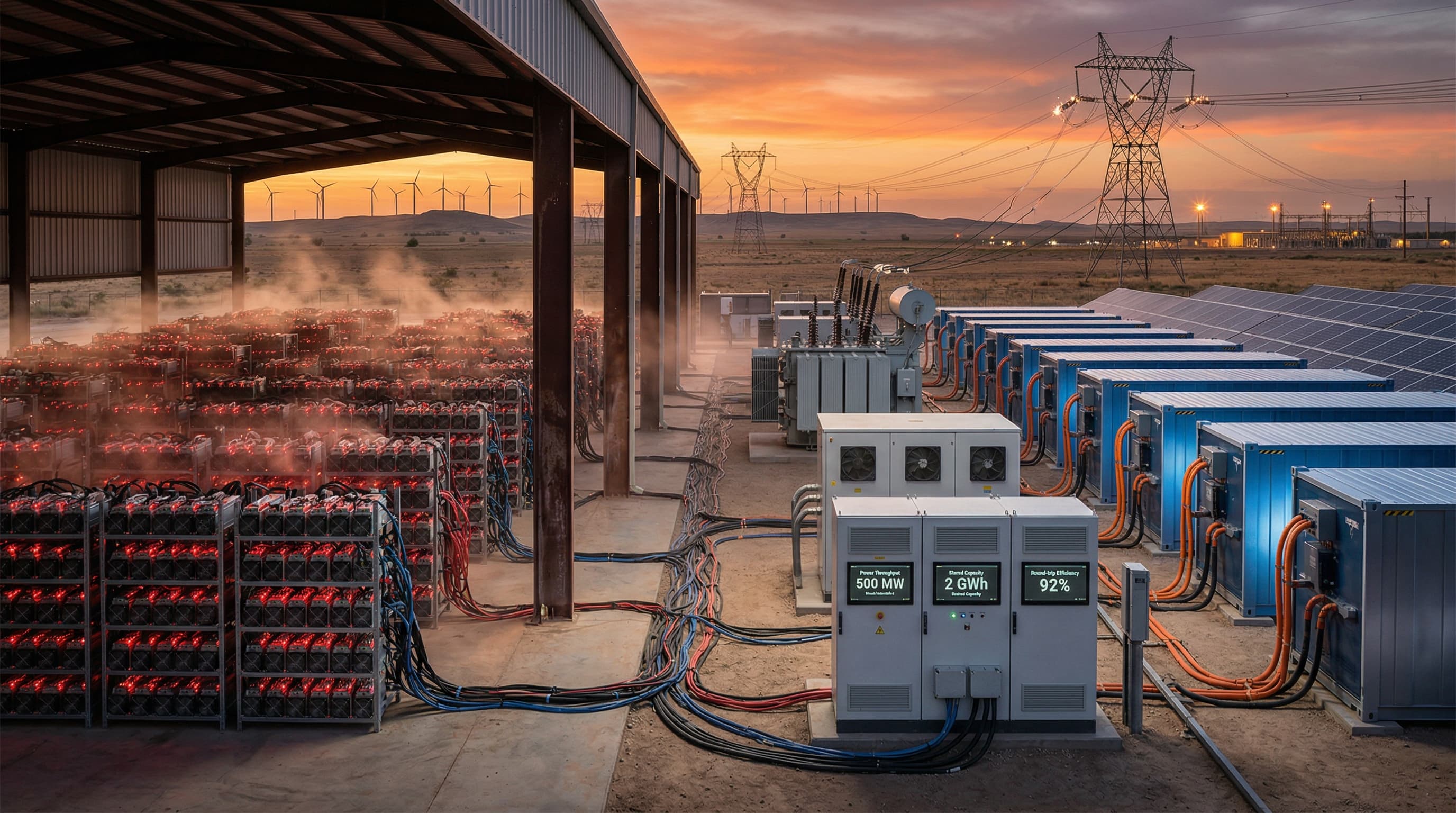
Sandia modeled a California ISO scenario with 30% renewable penetration. Brain-like AI controllers maintained 99.9% uptime during 1,000 disturbance events. Round-trip efficiency for batteries reached 92%, up 3% from standard systems.
Energy throughput increased 22% in peak hours. The system scales to 10 GW grids without added hardware. Intel reports Loihi 2 power draw at 25 W, versus 1 kW for conventional servers.
FERC Order 2222 enables distributed storage participation. AI unlocks aggregated 50 MW virtual power plants for markets. Revenue from ancillary services rises 28%, per NREL economic models.
Commercialization Timeline and Challenges
Sandia partners with Fluence Energy for field trials in Q3 2026. Technology readiness level stands at 6 after lab validation. Production chips cost USD 500 per unit at scale.
Challenges include cyber-secure spiking networks. Sandia integrated NIST-compliant encryption. Prototypes achieve IEC 61850 compatibility, meeting grid operator demands.
Venture funding for neuromorphic grid tech topped USD 200 million in 2025, PitchBook data shows. Ambri and Form Energy eye AI for LDES pilots. Deployments target 1 GW by 2028.
Brain-Like AI Controllers vs Existing Solutions
Siemens offers AI for substations using deep learning with 50 ms latency. GE Vernova's controllers deliver 10% efficiency gains. Sandia's neuromorphic approach provides ultra-low power and speed.
State Grid deployed similar tech in 5 GW pilots, Reuters reports. US firms lead scalable chips via Intel and IBM. McKinsey projects brain-like AI market share at 15% by 2030.
EV-to-grid applications coordinate 10,000 second-life batteries for 200 MW regulation. Costs drop to USD 80/kWh with V2G, Rocky Mountain Institute estimates.
Why Brain-Like AI Controllers Matter
Brain-like AI controllers redefine grid storage operations. Utilities cut costs 25% while boosting reliability amid 50% renewable growth. Watch Sandia trials and Fluence pilots for 2026 milestones.