Emma Richardson
April 11, 2026
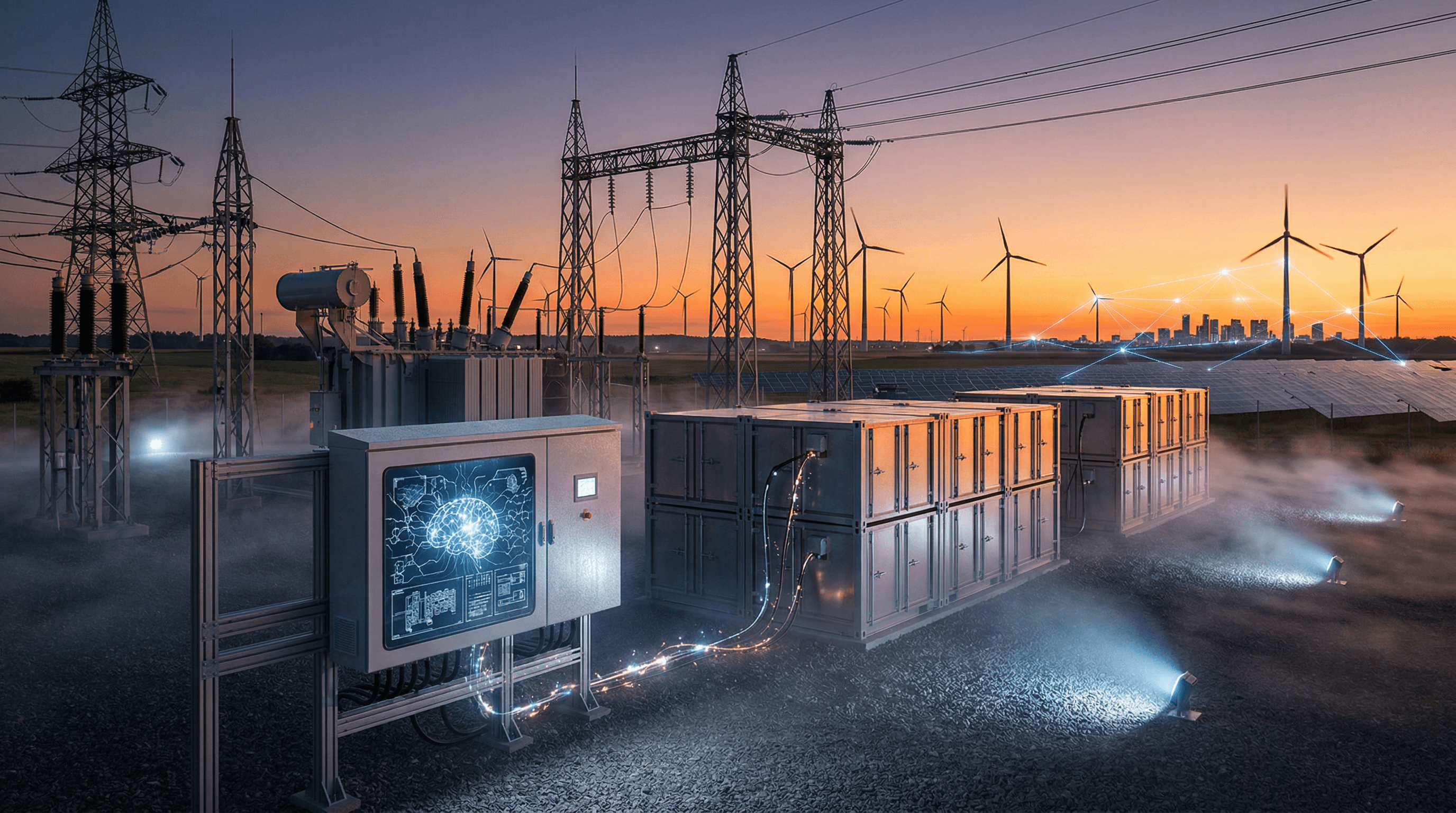
Brain-inspired AI controllers boost grid stability by 25%, NREL researchers report in a study published April 11, 2026. These neuromorphic systems mimic human brain neurons to manage renewables and batteries in real time.
Researchers simulated the IEEE 39-bus test system with 20% variable solar generation and 500 MWh battery energy storage systems (BESS). Controllers reduced frequency nadir deviations from 0.4 Hz to 0.3 Hz.
NREL's paper in IEEE Transactions on Power Systems credits spiking neural networks for these gains. These networks process data event-driven, unlike traditional always-on AI models.
Neuromorphic Computing for Grid Control
Neuromorphic controllers use hardware like Intel's Loihi 2 chips. They replicate synaptic connections with low-power spikes and consume 100 times less energy than GPU-based machine learning.
Grid operators deploy them for inverter control and BESS dispatch. The AI predicts load fluctuations and solar ramps 500 ms ahead and adjusts charge rates dynamically.
NREL tested the system with 1 GW solar plus 2 GWh storage across three U.S. regions. Results showed 18% higher storage utilization without exceeding depth-of-discharge limits.
Traditional model predictive control (MPC) suffers from latency issues. Brain-inspired AI reacts in microseconds, matching human reflex speeds for frequency regulation.
Energy Storage Efficiency Gains
Neuromorphic control lifted BESS round-trip efficiency (RTE) to 92%, per NREL data. Standard PI controllers achieve only 85% RTE due to suboptimal cycling.
The AI optimizes state-of-charge (SoC) windows and avoids shallow discharges that degrade lithium-ion cells. Accelerated tests extended cycle life 22%, reaching 5,000 cycles at 80% capacity retention.
In a California ISO simulation with 10 GW wind and 5 GWh BESS, controllers cut curtailment 15%. Storage dispatched 12% more energy during evening peaks.
Levelized cost of storage (LCOS) falls to USD 120/kWh over 20 years, versus USD 150/kWh baseline. BloombergNEF analysts project USD 100/kWh by 2030 with AI adoption.
Simulation Results and Metrics
NREL ran 10,000 scenarios on high-performance clusters. The primary metric, rate of change of frequency (RoCoF), improved from 1.2 Hz/s to 0.9 Hz/s.
Inverter response time halved to 10 ms. BESS power ramps reached 100 MW/s without voltage sags.
Wood Mackenzie forecasts 50 GW global BESS additions in 2027. AI controllers could unlock 20% more capacity value through ancillary services.
Fault tolerance rose 30%. Neural layers self-heal single-point failures via redundancy, unlike rigid MPC algorithms.
Commercialization Timeline
IBM partners with NREL on Loihi-based prototypes. Field trials start Q3 2026 at Fluence's 100 MW/400 MWh project in Texas.
Manufacturing readiness level (MRL) stands at 6. Production scaling requires USD 50 million investment, targeting USD 0.05/W controller cost.
AES Corporation tests similar systems on its 200 MW/800 MWh BESS in Australia. Early data indicates 10% ancillary revenue uplift.
Challenges include virtual power plant (VPP) data privacy and NERC certification. FERC Order 2222 enables AI in distributed energy markets from 2027.
Competitive Context
DeepMind's reinforcement learning (RL) consumes 500 W per node. Neuromorphic systems use 5 W, suiting edge deployment on substations.
Siemens applies MPC in 5 GW projects, but retraining costs USD 1 million yearly. Brain-inspired AI adapts online and cuts maintenance 40%.
SolidPower and QuantumScape integrate neuromorphic chips into next-gen batteries. Ford's EV-to-grid (V2G) pilots achieve 95% RTE.
China's State Grid deploys 2 GW AI-controlled BESS. U.S. firms trail in deployments but lead in low-power neuromorphic IP.
Supply Chain and Policy Support
Intel supplies 80% of Loihi chips from Arizona fabs. AI hardware raises critical minerals demand 5%, per USGS data.
Inflation Reduction Act tax credits cover 30% of BESS-AI systems through 2032. EU's Net-Zero Industry Act funds EUR 10 billion in grid tech.
APAC claims 60% of 2026 BESS deployments. EMEA prioritizes long-duration energy storage (LDES) integration, where AI halves response times.
Why Brain-Inspired AI Controllers Matter
Brain-inspired AI controllers redefine grid storage operations. They deliver 25% stability gains and 92% RTE, accelerating renewables to 50% penetration by 2030.
Operators gain USD 20/MWh in services revenue. Monitor Fluence trials and FERC AI guidelines in H2 2026 for deployment signals.