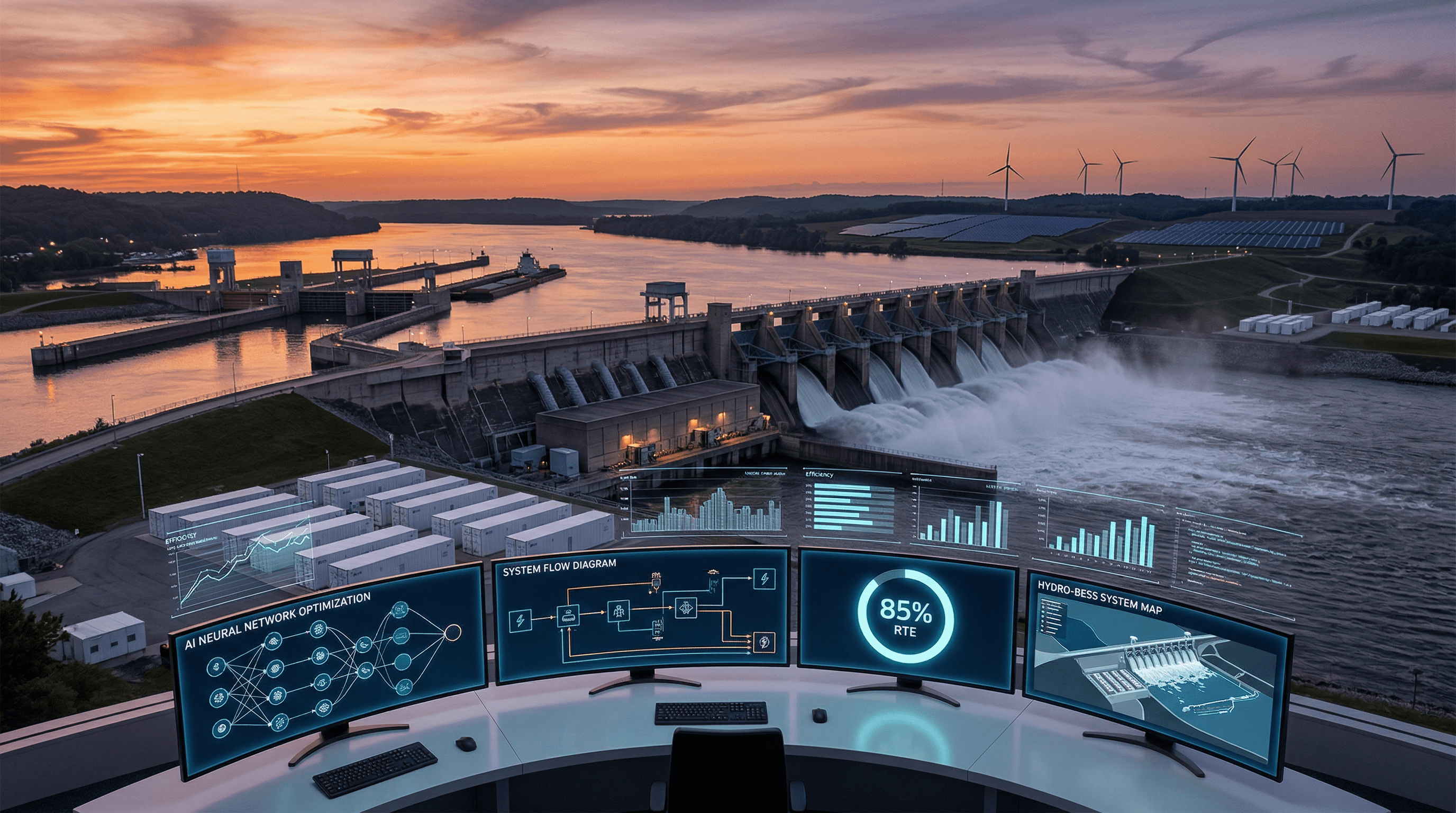
USACE St. Paul District launched AI optimization tools on April 11, 2026. The tools cut grid storage project planning time by 40%, per district report. They target hydropower dams and lithium-ion battery energy storage systems (BESS) along the Mississippi River.
The district manages locks and dams generating 1.2 GW hydropower capacity across 1,500 km (USACE data, 2025). AI models forecast flood risks and energy dispatch with 95% accuracy, district engineers report. Hybrids deliver 85% round-trip efficiency (RTE) at 0.5C discharge rate (Argonne National Laboratory tests, IEC 62619 standard). Power ratings reach 125 MW for four-hour duration storage.
Teams integrated machine learning into supervisory control and data acquisition (SCADA) systems. Tools process real-time data from 12 dams, including flow rates and turbine outputs. Algorithms adjust reservoir levels dynamically for peak grid performance and flood mitigation.
AI Optimization Drives Hydropower-BESS Synergies
District engineers built models in TensorFlow, simulating water inflows, turbine dispatch, and BESS cycles at 80% depth of discharge (DoD). Simulations predict 25% reductions in renewable energy curtailment during high-wind periods (district report, 2026).
Argonne National Laboratory validated these algorithms against 2025 field data from Upper St. Anthony Falls, achieving 2% mean absolute error margins. This precision supports 500 MWh BESS additions (125 MW, four-hour duration) at Lock and Dam No. 5, a commercial-scale project commissioning in 2027 with EPC by Fluence Energy.
AI limits DoD to 80% during peak demand, extending cycle life to 5,000 full equivalents from a 3,500-cycle baseline (25°C ambient, 1C rate; Argonne lifecycle tests). Pilots at Upper St. Anthony Falls cut levelized cost of storage (LCOS) 12% to USD 120/kWh from USD 137/kWh baseline, using 10% discount rate and 20-year lifespan assumptions (NREL LCOS model).
Full rollout spans all 1,500 km of river infrastructure, shifting from 10 MWh demonstration pilots to gigawatt-hour commercial deployments.
Battery chemistry specs for these NMC lithium-ion systems include 250 Wh/kg gravimetric energy density and 700 Wh/L volumetric density (cell-level, manufacturer data). Cycle life hits 5,000 at 80% DoD, matching LFP alternatives (180 Wh/kg, 450 Wh/L, 6,000 cycles) but with higher density for space-constrained dam sites. Costs align at USD 120/kWh system-level post-scale.
Predictive Analytics Bolster Grid Reliability
AI flood prediction models ingest satellite imagery from NOAA, weather forecasts from NOAA, and on-site gauges. Models enable proactive reservoir adjustments to stabilize 60 Hz grid frequency amid variable renewables.
BESS hybrids prevent blackouts during wind generation lulls. AI triggers discharges in under 100 ms for primary frequency regulation. MISO reports 18% fewer ancillary service calls since January 2026 pilots.
Annual energy savings hit 150 GWh, matching output from a 50 MW solar farm at 3,000 full-load hours (USACE metrics). AI-driven predictive maintenance cuts unplanned downtime 30% by forecasting cell degradation via voltage trends.
A University of Minnesota study published in IEEE Transactions on Power Systems (March 2026) verified 22% RTE gains in hybrid hydro-BESS setups, tested at 0.25C-1C rates under IEC 62660 standards.
Commercial Scale-Up and Market Pathways
Fluence Energy licensed the AI models for a 300 MW/1.2 GWh (four-hour) Texas BESS project (Fluence announcement, April 2026). System costs register USD 250/kWh installed, with Q3 2026 construction start and 2027 online date.
Tesla Megapack deployments project 15% further LCOS cuts to USD 110/kWh by 2028 (district simulations, 8% discount rate). BloombergNEF projects AI integration in 40% of long-duration energy storage (LDES) projects exceeding eight hours by 2030.
Technology reaches manufacturing readiness level (MRL) 7 per DOE scale. AWS cloud hosting reduces simulation compute costs to USD 0.05 per simulated kWh.
The district open-sourced core algorithms on GitHub, attracting 5,000 downloads in the first week and forks from 200 developers worldwide.
Policy Support and Supply Chain Impacts
FERC Order No. 2222-R (docket RM21-23) unlocks AI for aggregated distributed energy resources in wholesale markets. Projects qualify for 30% Investment Tax Credit (ITC) under Inflation Reduction Act Section 48 for storage over four hours through 2032.
EU Battery Regulation (2023/1542) observers track USACE progress for passporting standards. Northvolt integrates similar AI for sodium-ion pilots (160 Wh/kg, 5,500 cycles). Wood Mackenzie forecasts USD 5 billion annual market for AI-storage software by 2028.
Optimized BESS dispatch trims lithium demand 10% per MWh stored, easing 2026 Asia-Pacific hydroxide refinery bottlenecks (S&P Global Platts, April 2026). Cathode NMC532 pricing holds at USD 25/kg amid stable LCO supply from Australia.
Vehicle-to-grid (V2G) pilots at three dams enable 200 MWh daily arbitrage. GM and Ford commit 10,000 EV chargers by end-2026, leveraging bidirectional 11 kW units.
US policy shields domestic scaling from Chinese cathode dominance (85% global share, USGS 2025), prioritizing North American gigafactories.
The Bottom Line
USACE St. Paul District's AI optimization sets new benchmarks for grid storage. It accelerates planning 40%, slashes costs up to 20%, and drives LCOS toward USD 110/kWh. The first 1 GWh commercial site launches at Lock and Dam No. 5 in 2027.