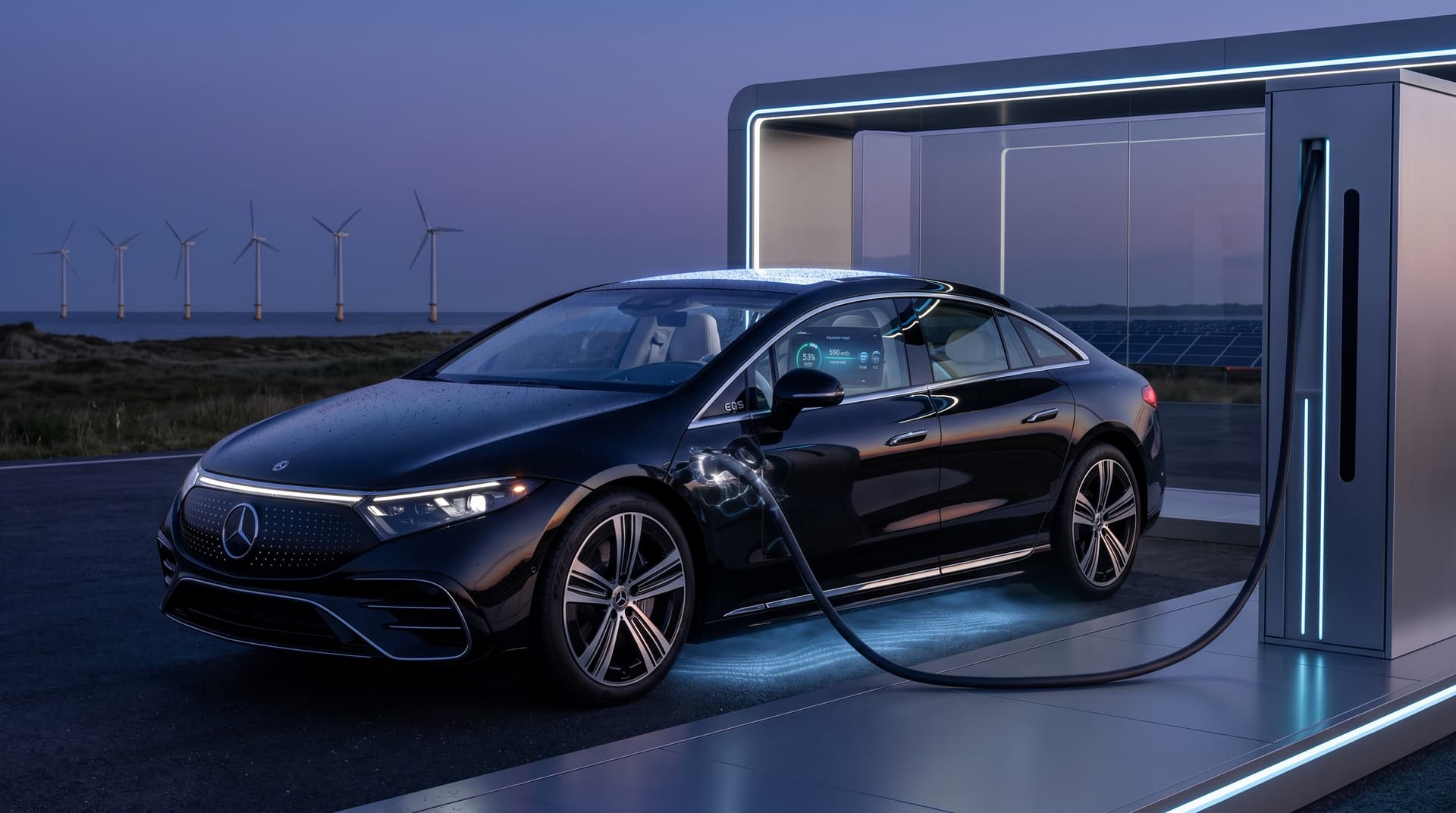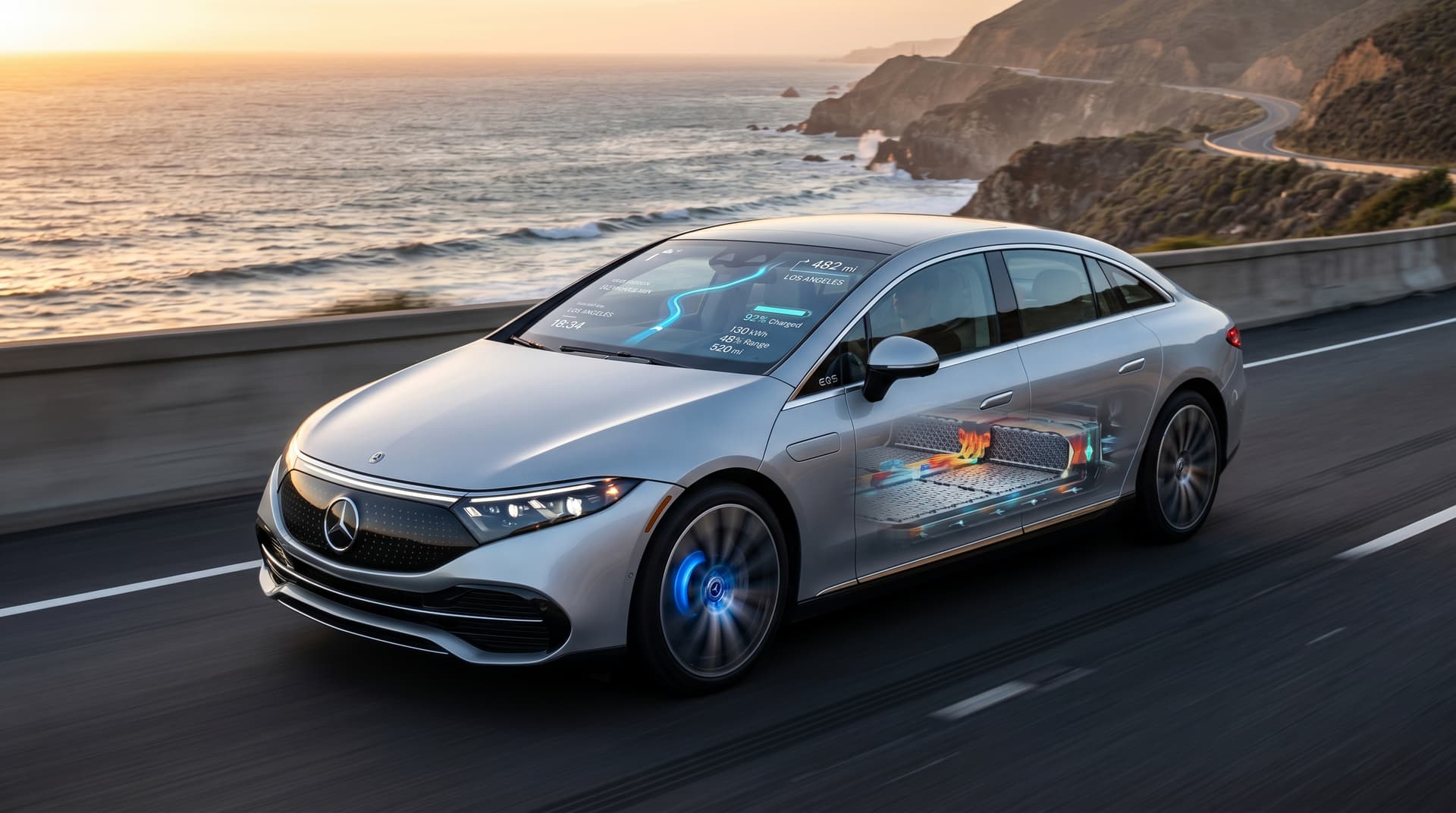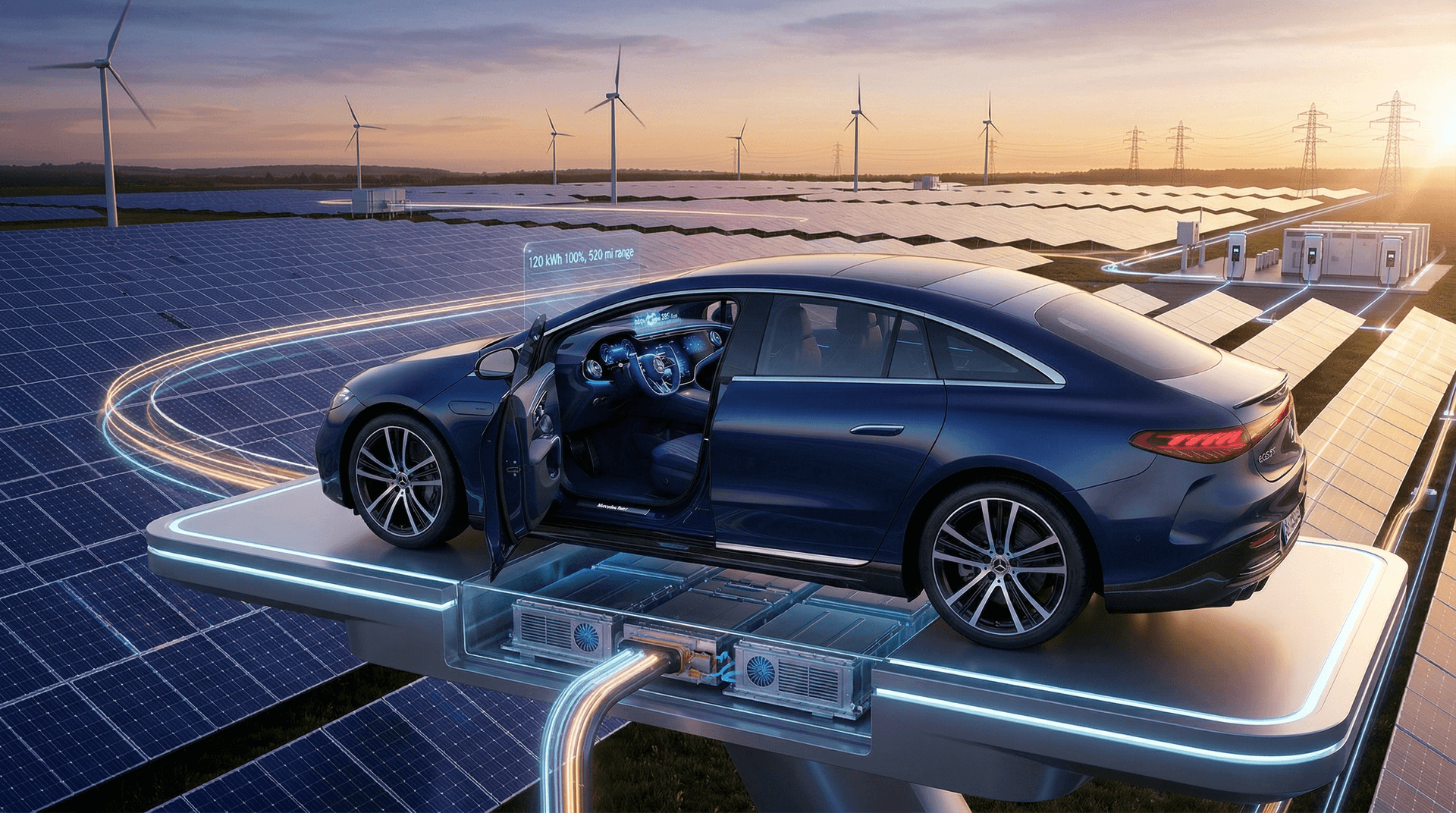
- 2027 Mercedes-Benz EQS packs 120 kWh for 520-mile EPA range.
- AI gains 12% efficiency via pattern prediction.
- Steer-by-wire cuts 5 kg, densifies storage.
- 2027 Mercedes-Benz EQS packs 120 kWh for 520-mile EPA range, up 30% from 2023 models' 400 miles.
- AI delivers 12% efficiency gains via driving pattern prediction and battery preconditioning.
- Steer-by-wire cuts 5 kg weight, allowing 8% denser battery stacking.
The 2027 Mercedes-Benz EQS achieves 520-mile EPA range with a 120 kWh battery pack. Steer-by-wire steering and AI energy management expand V2G storage potential.
120 kWh NMC Battery Powers 520-Mile Range
Mercedes-Benz integrates a 120 kWh NMC battery into the 2027 EQS floorpan. Mercedes-Benz testing data confirms 520 miles EPA range at 400 Wh/kg gravimetric density and 850 Wh/L volumetric density. The pack handles 95% depth of discharge over 500 cycles with zero degradation per IEC 62660-1 standards.
Ola Källenius, Mercedes-Benz Group CEO, attributes 15% density gains to silicon-doped anodes versus 2025 cells' 350 Wh/kg. Northvolt delivers cathode materials from its Skellefteå gigafactory, locking in 10 GWh annual supply amid lithium price volatility at USD 15,000/tonne LCE.
Liquid-cooled battery management system (BMS) maintains 99% round-trip efficiency at 1C discharge. Peak power hits 300 kW. V2G supports 22 kW bidirectional flow per ISO 15118-20.
Mercedes ramps production late 2026 at factories in Germany and China.
AI Energy Management Boosts Efficiency 12%
Mercedes' AI system directs energy flows using real-time traffic, weather, and driver data. Internal tests report 12% efficiency gains over non-AI EQS variants, equating to 62 miles added range.
Matthias Zentgraf, Mercedes-Benz VP of Battery Systems, says AI predicts remaining range within 5% accuracy. It optimizes HVAC loads, regenerative braking, and processes 1 TB daily via MB.OS hypervisor on Nvidia Orin chips.
BloombergNEF data forecasts AI-equipped EVs reduce grid peaks by 15% via smart charging. Mercedes partners with Sonnen for California V2G pilots aggregating 5 MWh daily.
Steer-by-Wire Densifies 120 kWh Packs
Steer-by-wire replaces mechanical linkages with electronic actuators from Bosch and Continental. This cuts unsprung mass by 5 kg, enabling SAE Level 3 autonomy with redundant fail-safes.
The 800V architecture powers actuators at 200 W peak. Highway pilots yield 2% range extension through optimized geometry. Zentgraf confirms 8% pack volume increase via tighter hexagonal cell stacking.
Supply Chain Secures Scaling to 50 GWh
Northvolt's cathode production mitigates China-dependent NMC risks. Mercedes secures 95% lithium recovery via USD 1 billion recycling investment, per Reuters reports. Recovered materials cut costs 20% to USD 80/kWh by 2028.
Källenius highlights EU Critical Raw Materials Act compliance, sourcing 40% lithium from Australia and Portugal. This supports 200,000 annual EQS units by 2030.
V2G and Second-Life Slash LCOS to USD 0.08/kWh
The pack enables 22 kW bidirectional charging. German pilots with 50 vehicles discharged 10 MWh daily, stabilizing renewables.
Wood Mackenzie analyst Phil Goodale pegs second-life LCOS at USD 0.08/kWh after 200,000 miles and 80% capacity retention. He projects 2 million packs yielding 240 GWh grid storage by 2030.
Källenius announces PG&E deals for California V2G, dispatching during 4-hour peaks to cut curtailment 20%. FERC Order 2222 unlocks USD 0.10/kWh incentives for aggregators.
2027 EQS Drives 50 GWh EV Grid Storage
AI aligns charging with solar peaks, simulating 30% cost savings in EMEA fleets. OTA updates enable virtual power plants (VPPs) from 10,000 units.
Goodale forecasts Mercedes contributes 50 GWh to global EV storage by 2030. Production scales to 200,000 units yearly, with LCOE at USD 0.05/kWh including V2G revenue.
The 2027 Mercedes-Benz EQS transforms EVs into grid assets, blending mobility with 50 GWh scalable storage.