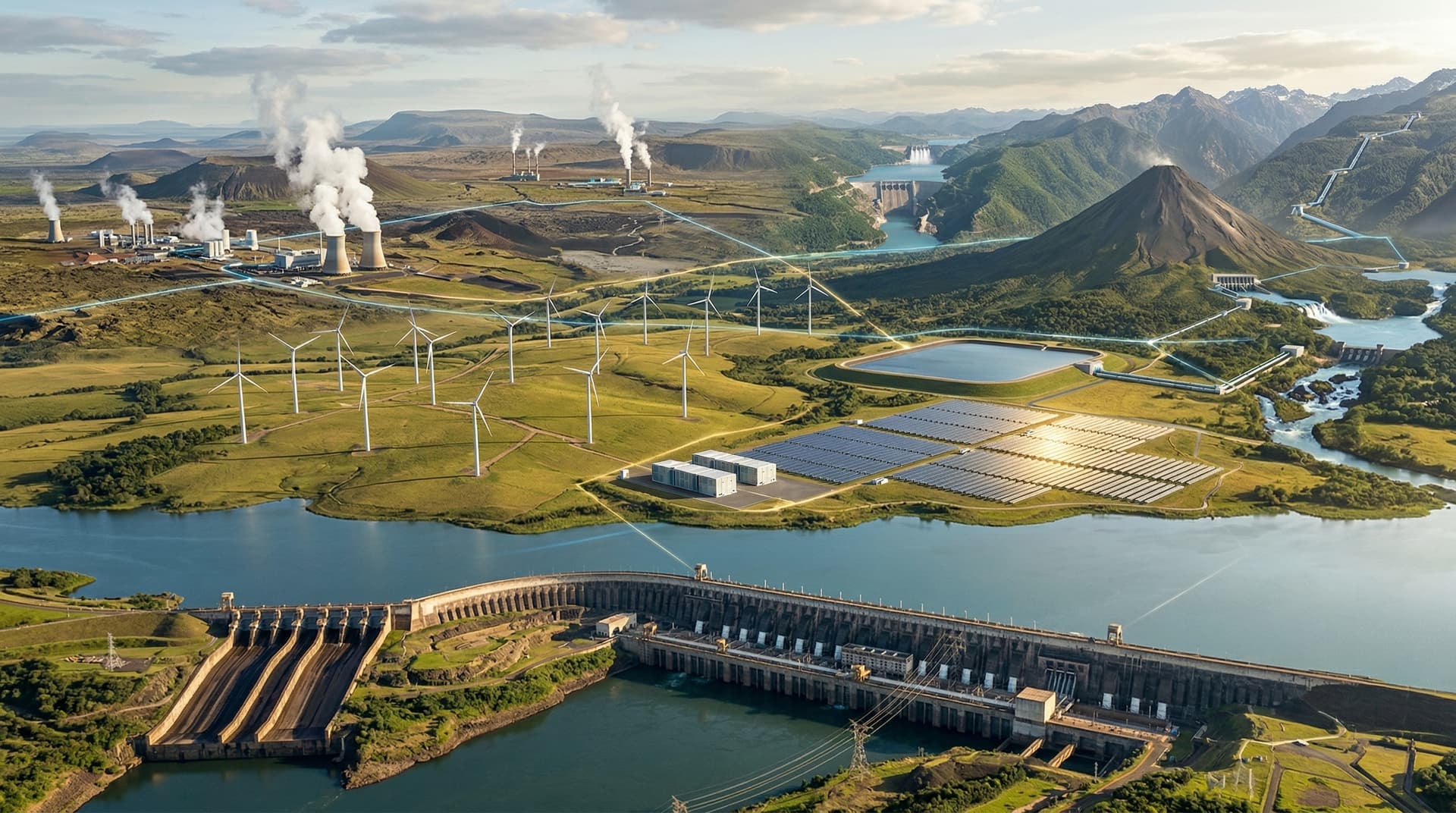
Albania, Bhutan, Costa Rica, Iceland, Kenya, Paraguay, and Uruguay generated 100% renewable electricity through March 2026. IRENA reported this on April 12, 2026.
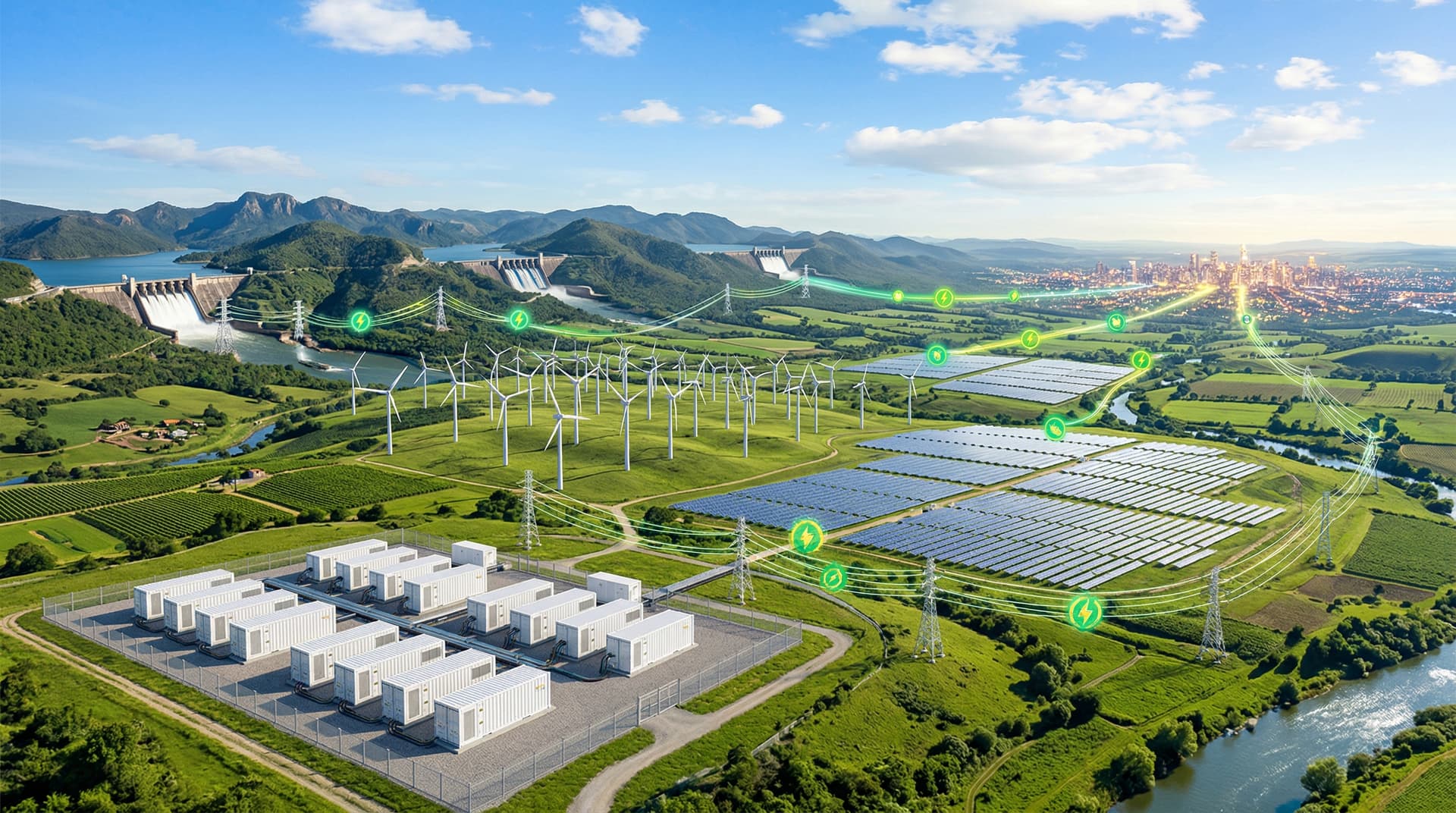
These countries rely on hydro, wind, solar, and geothermal sources. Long-term policies drove the shift. Energy storage now stabilizes grids against intermittency.
Countries Achieving 100% Renewable Electricity
Albania produces 100% from hydropower, with 2.8 GW capacity on the Drin River cascade (IRENA). The grid faces dry-season shortages, prompting 50 MW/200 MWh lithium-ion pilots commissioning in 2026.
Bhutan operates run-of-river hydro plants totaling 2.3 GW, exporting surplus to India. Minimal storage needs exist due to baseload hydro, but 20 MW/80 MWh pumped hydro upgrades start 2027.
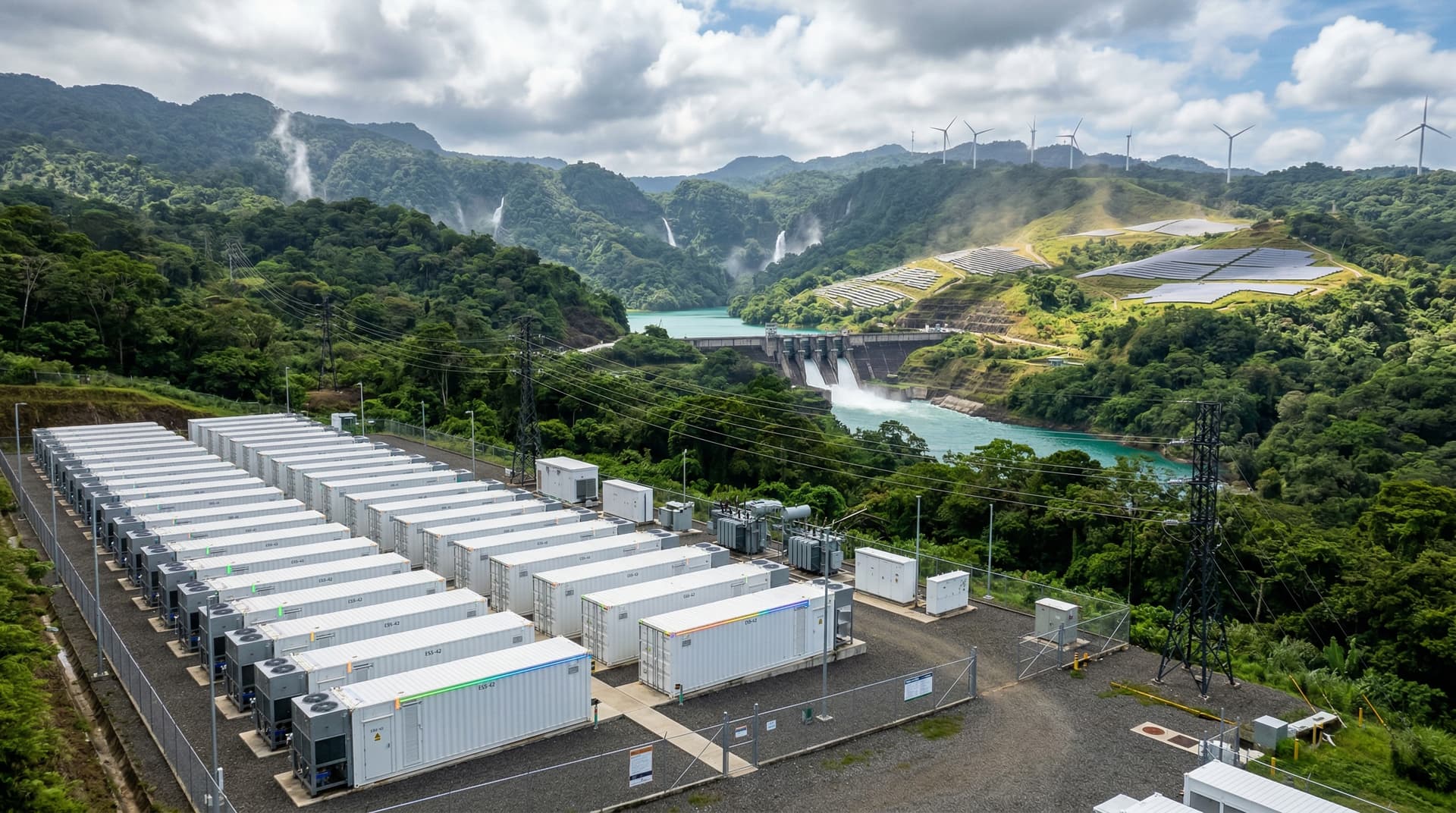
Costa Rica blends geothermal (13%) and hydro (68%), supported by 1.7 GW renewables. It deployed 100 MW/400 MWh vanadium flow batteries in 2025 for dry-season support (IDB funding).
Iceland sources 30% from geothermal and 70% from hydro, yielding 3.5 GW total. Landsvirkjun added 30 MW/120 MWh lithium-iron-phosphate storage at 250 Wh/kg energy density for wind integration.
Kenya achieves 100% via geothermal (46%), hydro (34%), and 400 MW wind (IRENA). Geothermal provides baseload, but wind drives 50 MW/200 MWh iron-air LDES deployment by Fluence.
Paraguay harnesses 7 GW from its Itaipu Dam share under the 1973 treaty. Peak shaving requires 100 MW/400 MWh sodium-ion storage trials, targeting 85% round-trip efficiency.
Uruguay mixes wind (45%), solar (5%), and hydro. It leads with 200 MW/800 MWh lithium-ion systems from Tesla, averaging 4-hour duration at USD 120/kWh installed cost.
Utilities invested USD 15 billion in generation assets since 2015 (IRENA).
Policy Mechanisms Driving the Transition
Costa Rica's 2019 Renewable Energy Mandate targeted 100% clean power by 2030. Feed-in tariffs at USD 0.12/kWh accelerated adoption, met four years early.
Uruguay's Law 19.947 enabled auctions for 5 GW wind at USD 70/MWh. Recent amendments mandate 20% storage co-location for new renewables.
Kenya's Feed-in Tariff Policy caps rates at USD 0.11/kWh for geothermal. The 2024 Storage Roadmap sets 500 MW LDES by 2028, with tax credits up to 30%.
Bhutan's 2020 National Energy Policy subsidizes hydro exports to India at USD 0.08/kWh. Albania's 2021 Power Sector Reform allocates 20% of GDP (USD 2 billion) to hydro and 100 MW storage upgrades.
Iceland's 2018 Energy Master Plan phases out fossils by 2040. Paraguay enforces Itaipu Treaty quotas, adding storage incentives in 2025 bilateral talks.
Tax credits, priority dispatch, and 20-year power purchase agreements (PPAs) ensure cost recovery. Policies now include storage mandates tested to IEC 62933 standards.
Energy Storage Demand Surges
Intermittent renewables require batteries for frequency regulation and peak shifting. Uruguay commissioned 200 MW/800 MWh lithium NMC systems in 2025 (BloombergNEF), with 3,500 cycles at 90% depth-of-discharge.
Costa Rica installed 100 MW/400 MWh flow batteries, offering 10-hour duration, 75 Wh/L energy density, and 20,000 cycles (IRENA). Kenya advances 500 MW LDES via 2024 Roadmap, supplied by Fluence and Tesla.
Utility-scale storage hits 85% round-trip efficiency at 0.25C discharge rates (IRENA). Levelized cost of storage (LCOS) falls to USD 0.08/kWh, undercutting gas peakers at USD 0.12/kWh.
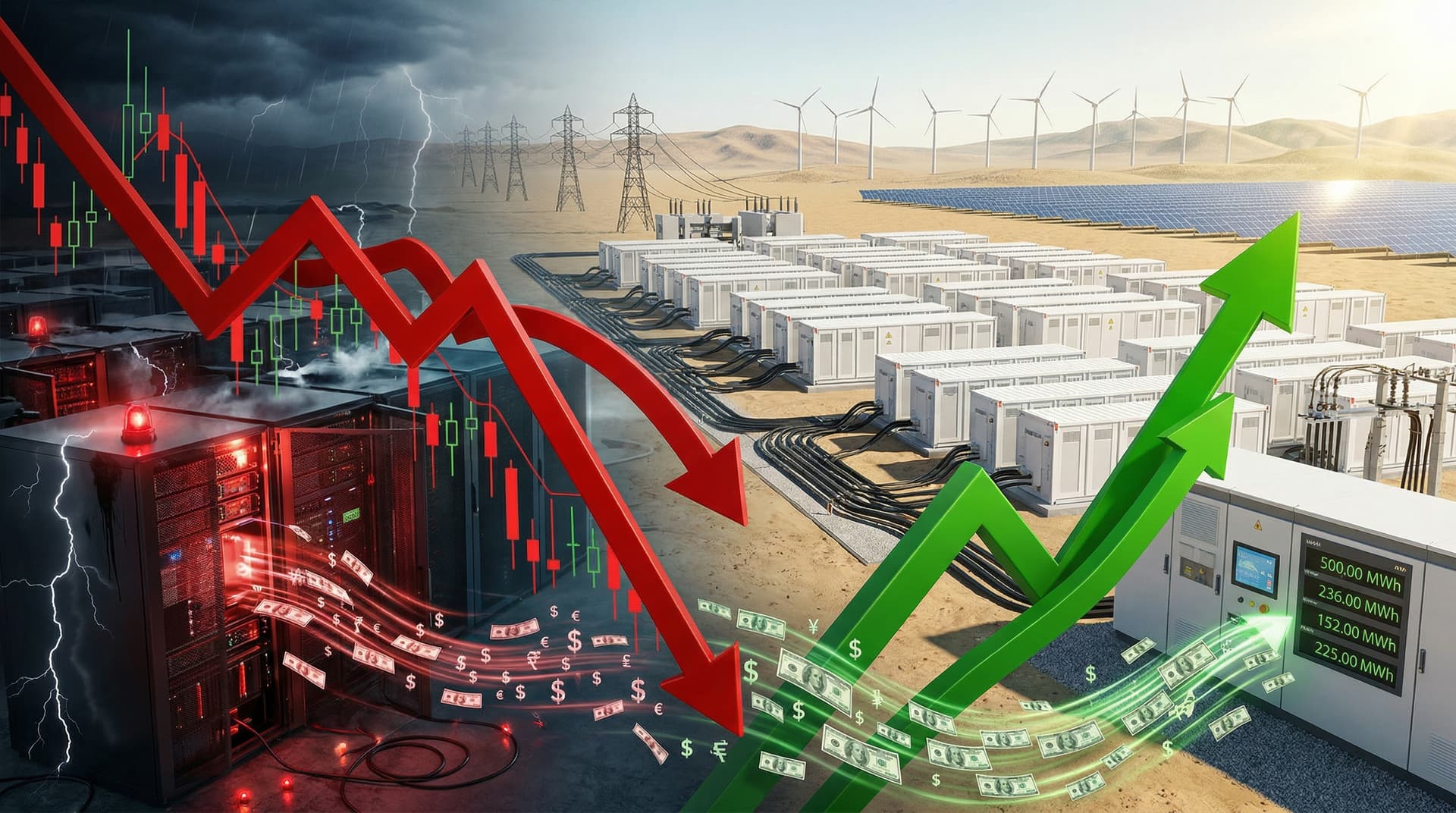
IRENA forecasts USD 50 billion in storage investments by 2030 from these 100% renewable electricity grids. Sodium-ion emerges for LDES, with 160 Wh/kg density and USD 80/kWh costs.
Grid Upgrades Enable Reliability
Smart grids handle variability with advanced controls. Iceland invests USD 500 million in 500 km HVDC lines, exporting 1 GW geothermal to Europe via Viking Link.
Albania deploys smart inverters across 2 GW hydro, reducing curtailment 12%. Uruguay's 2025 Grid Modernization Plan installs synchrophasors over 500 km lines.
Kenya pilots vehicle-to-grid (V2G) with 50,000 EVs, cutting losses 15% (Wood Mackenzie). These upgrades boost utilization 20% under IEEE 1547 standards.
Siemens Energy and ABB secure USD 10 billion in EPC contracts for substations and converters.
Financial and Market Impacts
These milestones attract capital. Uruguay issued USD 2 billion green bonds at 4% yield in March 2026. Costa Rica obtained USD 1.5 billion from IDB for storage expansion.
Battery orders surge 30% year-on-year (S&P Global Platts). Supply chains shift to sodium-ion LDES; Asia-Pacific commands 60% cathode production (IRENA).
US FERC Order 2023 unlocks 10 GW storage. EU REPowerEU allocates EUR 20 billion for grids. Global storage market projects 25% CAGR to 2032, reaching USD 25 billion annually.
Lithium supply from Australia and Chile faces tariffs, pushing sodium-ion from China at 40% lower cost.
Policy Comparison Table
| Country | Key Policy | Storage (MW/MWh) | Investment (USD bn) | |-------------|---------------------|------------------|---------------------| | Uruguay | Law 19.947 | 200/800 | 3.2 | | Costa Rica | 2019 Mandate | 100/400 | 2.1 | | Kenya | 2024 Roadmap | 50/200 | 1.8 | | Albania | 2021 Reform | 50/200 (pilot) | 1.2 | | Iceland | 2018 Master Plan | 30/120 | 0.8 | | Paraguay | Itaipu Treaty | 100/400 (trial) | 1.5 | | Bhutan | 2020 Energy Policy | 20/80 (planned) | 0.5 |
These frameworks guide Americas and EMEA transitions. China aims for 100% renewables by 2050 with 500 GWh storage.
Outlook for 100% Renewable Electricity
Seven countries demonstrate policy-driven 100% renewable electricity succeeds. Energy storage demand reaches USD 100 billion annually by 2030. Grid investments and auctions position next leaders like Chile and Morocco.