
- Gallup Q1 2026: 50% US workers use AI, spiking power demand.
- Data centers hit 105 GW by 2030 (BloombergNEF), needing storage.
- Q1 2026 adds 3.2 GW storage, up 25% YoY (EIA).
Key Takeaways
- Gallup Q1 2026 poll: 50% of US employees now use AI at work, a landmark threshold.
- AI daily/weekly usage reaches 28% all-time high per Gallup.
- Data centers to need 105 GW by 2030, per BloombergNEF, boosting grid-scale battery storage.
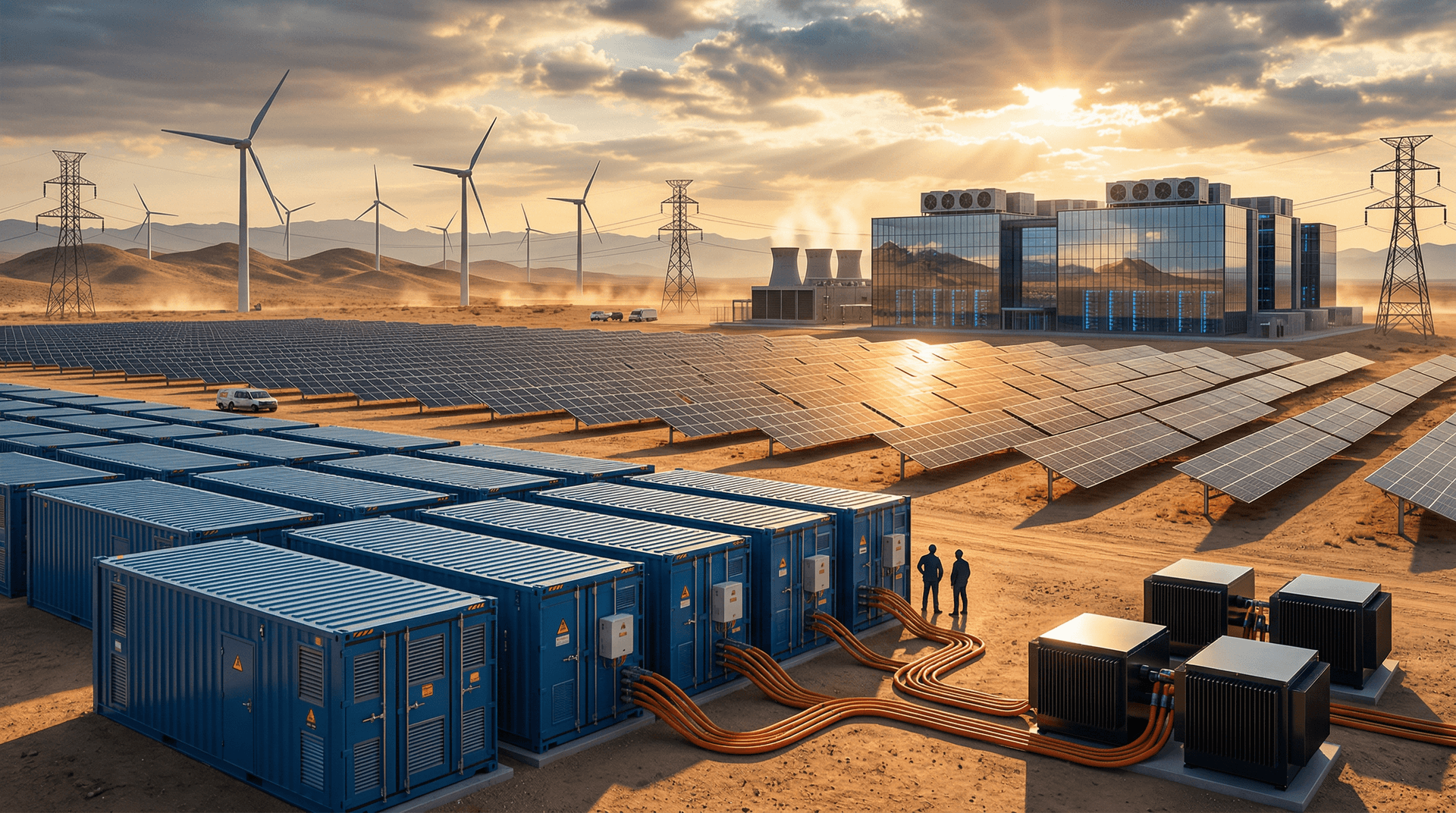
Gallup's Q1 2026 poll shows 50% of US employees use AI at work. This drives grid-scale battery storage demand to support data centers and solar-wind integration.
AI Adoption Fuels Data Center Power Surge
The poll reports 28% daily/weekly AI usage, up sharply. Gallup analyst Lydia Saad notes 65% of workers report productivity gains from AI tools.
BloombergNEF projects US data centers require 105 GW by 2030. This marks a 450% rise from 2022 levels. Rachel Slattery, BloombergNEF head of global power markets, states AI inference alone adds 200 TWh annually by 2030.
Microsoft added 10.5 GW AI capacity commitments in 2025, per company filings. Google plans 7 GW more by 2030. Utilities report doubled peak loads in Virginia and Texas, per EIA data.
Big tech signed 24 GW renewable PPAs since 2023, reports Reuters. Solar and wind pair with grid-scale battery storage to meet firm power needs.
Grid-Scale Battery Storage Projects Accelerate
NextEra Energy started construction on a 500 MW / 2 GWh solar-plus-storage project in California. A 15-year data center PPA backs it. LFP batteries cost USD 132/kWh installed.
Wood Mackenzie data shows 12% year-over-year cost drop. Revenue includes USD 60/kW-year capacity payments and ancillary services. Round-trip efficiency hits 92% at 0.25C discharge.
ERCOT interconnection queue lists 15 GW storage. 40% co-locates with 10 GW solar. Fluence Energy secured a 300 MW / 1.2 GWh contract for an Austin AI data center. Commissioning: Q4 2026.
Jim Spencer, Wood Mackenzie principal analyst, says: "AI data centers justify 20-25% higher storage procurements in 2026 bids."
Renewable Integration Relies on Grid-Scale Battery Storage
US solar capacity hit 200 GW, wind 150 GW by Q1 2026, per EIA. California curtailed 5 TWh solar last year due to midday-evening mismatches.
Grid-scale battery storage shifts output to peaks. Arevon Energy's 409 MW / 1.6 GWh Slate project in Arizona captures USD 150/MWh arbitrage spreads. Tested to IEC 62619 standards.
AWS signed 5 GW solar-plus-storage deals. FERC data shows grid congestion delays 30% of interconnections. FERC Order 2023 mandates 5-year timelines.
Nevada requires 2 GW storage by 2028 for solar firming. Data centers link 70% new capacity to renewables for ESG goals.
Cost Declines and Financing Trends
Four-hour grid-scale battery storage costs fell to USD 145/kWh in 2025, per NREL. This yields USD 80/MWh LCOE. Competitive with gas peakers at USD 90/MWh.
Bank of America forecasts USD 50 billion US storage investments through 2028. Blackstone deployed USD 2.5 billion last quarter into projects.
Lisa Johnson, NREL energy storage director, notes: "10-hour iron-air batteries cut LCOS to USD 65/MWh for wind integration. Achieves 92% RTE over 10,000 cycles."
Q1 2026 added 3.2 GW utility-scale storage. That's 25% year-over-year growth per EIA.
Policy Supports Grid-Scale Battery Storage Boom
IRA Section 45X provides USD 45/kWh manufacturing credits. California's SB 100 mandates 15 GW storage by 2030 for 60% renewables.
Texas runs 4 GW operational storage. Georgia abatements attract 1 GW solar-wind-storage. Dominion Energy targets 2,500 MW batteries by 2028 in Virginia.
PJM issued 1.2 GW storage RFPs in March 2026. Favors solar co-location. Wood Mackenzie predicts 12 GW annual additions through 2030.
AI growth cements grid-scale battery storage as essential for solar-wind-data center synergy. FERC reforms will speed 50 GW queued projects.


