- FERC Order 1920 requires AI data center transparency for 10 GW storage.
- Data centers double power use to 1,000 TWh by 2026 (IEA).
- Transparency cuts queues 70%, lowers LCOS to USD 140/kWh.
FERC Chair Willie Phillips demands AI data center transparency on power use. This drives grid storage policies under Order 1920, issued May 13, 2024. Data centers consumed 460 TWh globally in 2022, doubling to 1,000 TWh by 2026 (IEA, 2024).
Transparency curbs 20-50% load surges on utilities (IEA, 2024).
AI Power Demands Strain Grid Storage Capacity
Microsoft and Google deploy 100 MW+ AI data centers in Texas and Virginia. Each draws 500 MW, matching small cities (EIA, 2024).
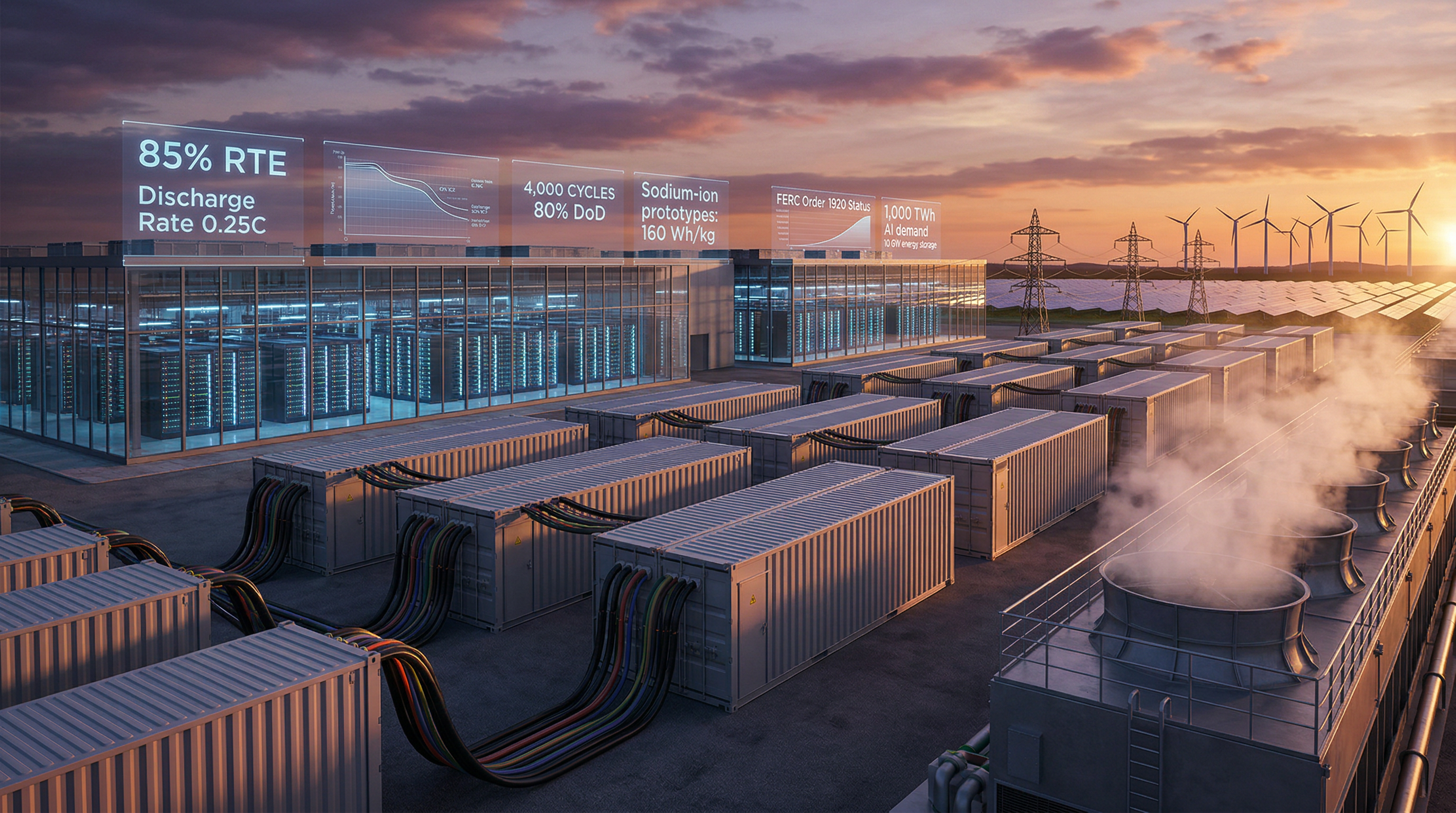
Grid operators deploy 4-hour lithium-ion (Li-ion) batteries for peak shaving. These deliver 85% round-trip efficiency (RTE) at 0.25C discharge (NREL, 2023).
Li-ion packs hit 150-200 Wh/kg energy density and 4,000+ cycles at 80% depth-of-discharge (DoD) (Sandia National Labs, 2023).
FERC Order 1920 Fast-Tracks Grid Storage Policy
FERC Order 1920 reforms 2 TW interconnection queues. It prioritizes storage in ERCOT and PJM high-load zones (FERC docket RM22-13-000).
AI data center transparency slashes delays from 5 years to 18 months.
California aims for 5 GW storage by 2027 via AB 2514. Transparent loads enhance dispatch models (CPUC, 2024).
Surging RFPs Target Energy Markets Viability
Utilities issue RFPs for 1 GWh+ batteries. Bidders eye $50/MWh arbitrage in CAISO (CAISO Q3 2024 data).
Behind-the-meter (BTM) 2-hour Li-ion costs USD 200/kWh. IRA Section 48 ITC offers 30-50% credits (US Treasury, 2024).
Load opacity pushes levelized cost of storage (LCOS) above USD 150/MWh (Lazard LCOE v17, 2024).
IEA report forecasts 1,000 TWh demand.
Crypto Opacity Lessons for Grid Storage
Crypto miners consume 120 TWh yearly, mirroring AI (IEA, 2024). Hidden loads strain grids.
CoinGecko Fear & Greed Index dropped to 23 on October 10, 2024, amid energy costs (CoinGecko, 2024).
Bitcoin reached USD 74,990; Ethereum USD 2,354 (CoinGecko, Oct 10, 2024).
CoinGecko index ties sentiment to power prices.
Renewable-storage hybrids cut miner curtailments 30% (NREL, 2024).
Batteries Bolster High-Load Grid Stability
ERCOT added 3 GW batteries in 2024. They dispatch in under 1 second for frequency control (ERCOT, 2024).
Sodium-ion pilots achieve USD 120/kWh at 160 Wh/kg (CATL, 2024).
PJM's 250 GW queue sees co-located storage reduce upgrade costs 40% (PJM Interconnection, 2024).
Stacked Revenues Secure Energy Markets Projects
Developers stack USD 100/kW-year ancillary services with arbitrage. 4-hour LFP batteries manage AI peaks at USD 140/kWh LCOS (BloombergNEF, 2024).
Form Energy's iron-air LDES targets 100 hours at USD 50/kWh.
PJM RFPs reach 5 GW by 2027.
Federal Energy Regulatory Commission Order 1920 advances storage.
Global Policies Mandate AI Data Center Transparency
EU Battery Regulation (EU) 2023/1542 demands quarterly kWh reports.
Singapore deploys 10 GWh storage with APAC hyperscalers.
Transparency enables USD 50 billion investments by 2030 (BloombergNEF Q3 2024).
AI data center transparency fortifies grids against 1,000 TWh growth.