- PNNL AI screened 1,440 pyrolysis combinations for optimization.
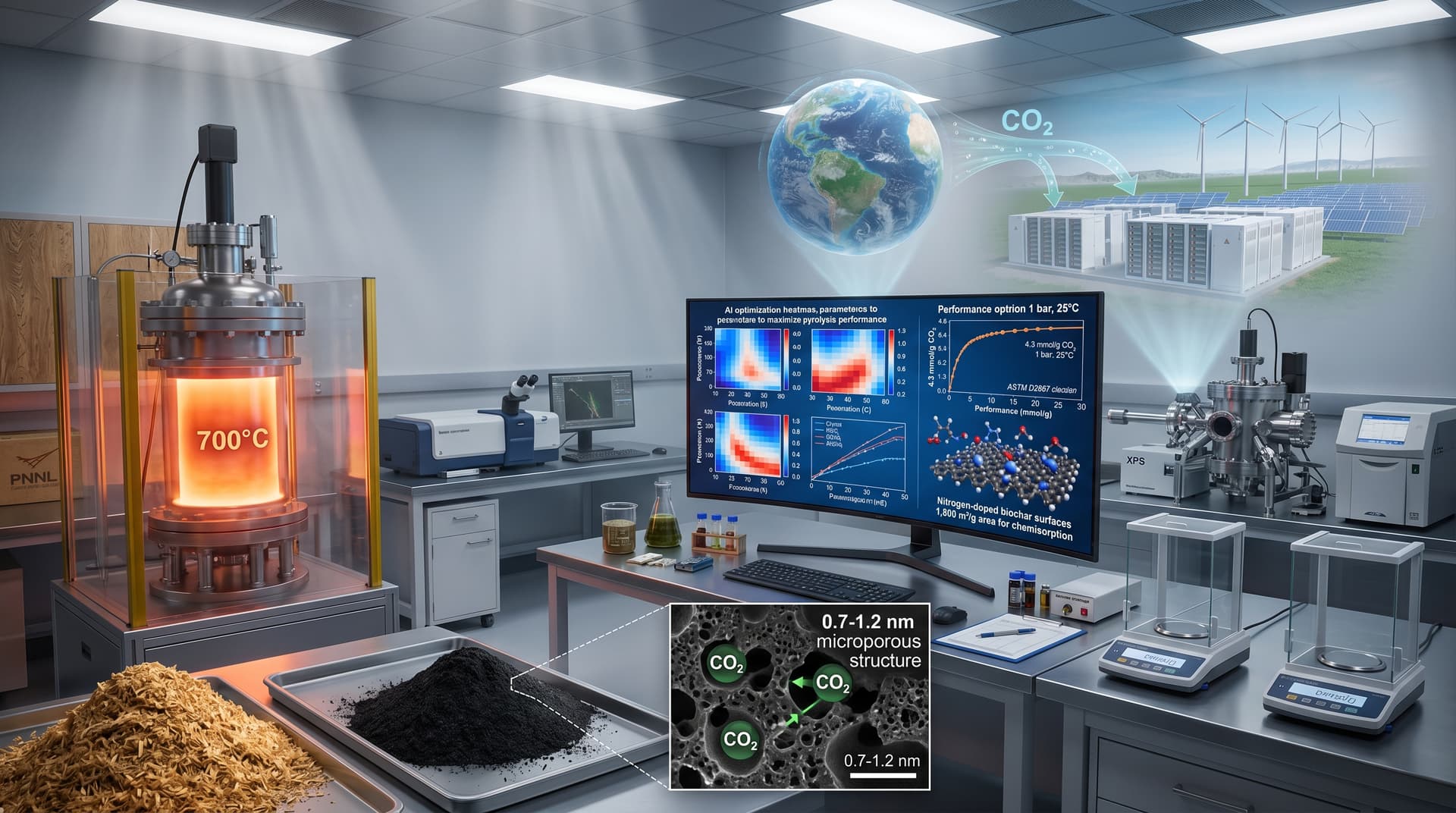
- 700°C pine biochar achieves 4.3 mmol/g CO2 adsorption, 72% above average.
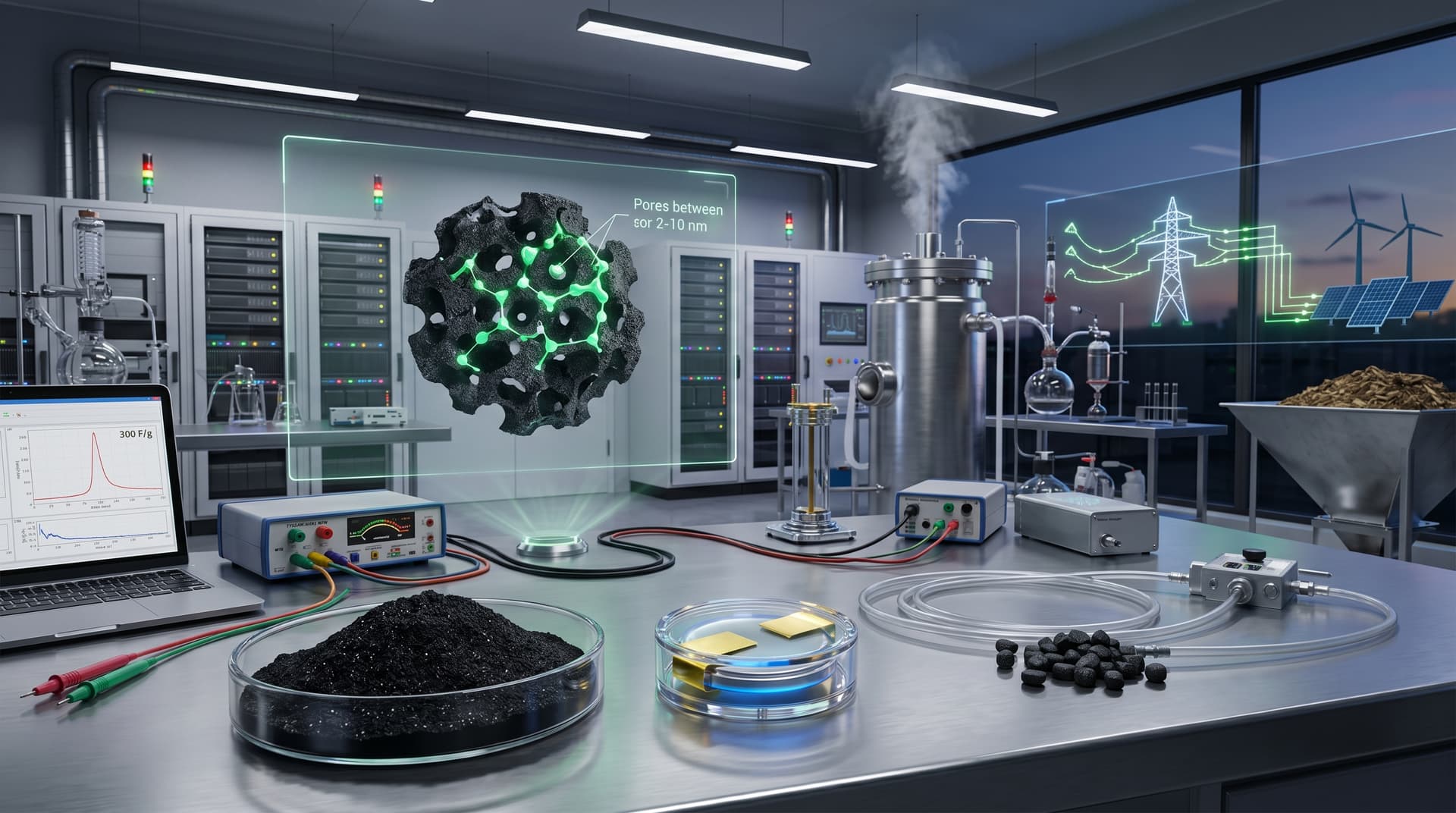
- Supercapacitors deliver 300 F/g with 20,000-cycle retention.
By Priya Mensah, Battery Tech Reporter
Pacific Northwest National Laboratory (PNNL) unveiled AI biochar carbon capture technology that achieves a record 4.3 mmol/g CO2 adsorption capacity, per EurekAlert on April 15, 2026.
PNNL materials scientist Dr. Hao Chen led the project. AI models predict optimal pyrolysis parameters to maximize CO2 binding sites in biochar derived from biomass waste.
AI Screens 1,440 Pyrolysis Combinations
Machine learning analyzed 1,440 feedstock types, temperatures from 400-900°C, and durations. Dr. Chen's team trained models using Raman spectroscopy and XPS data to forecast micropore volumes equivalent to 1,200 Wh/L for energy storage applications.
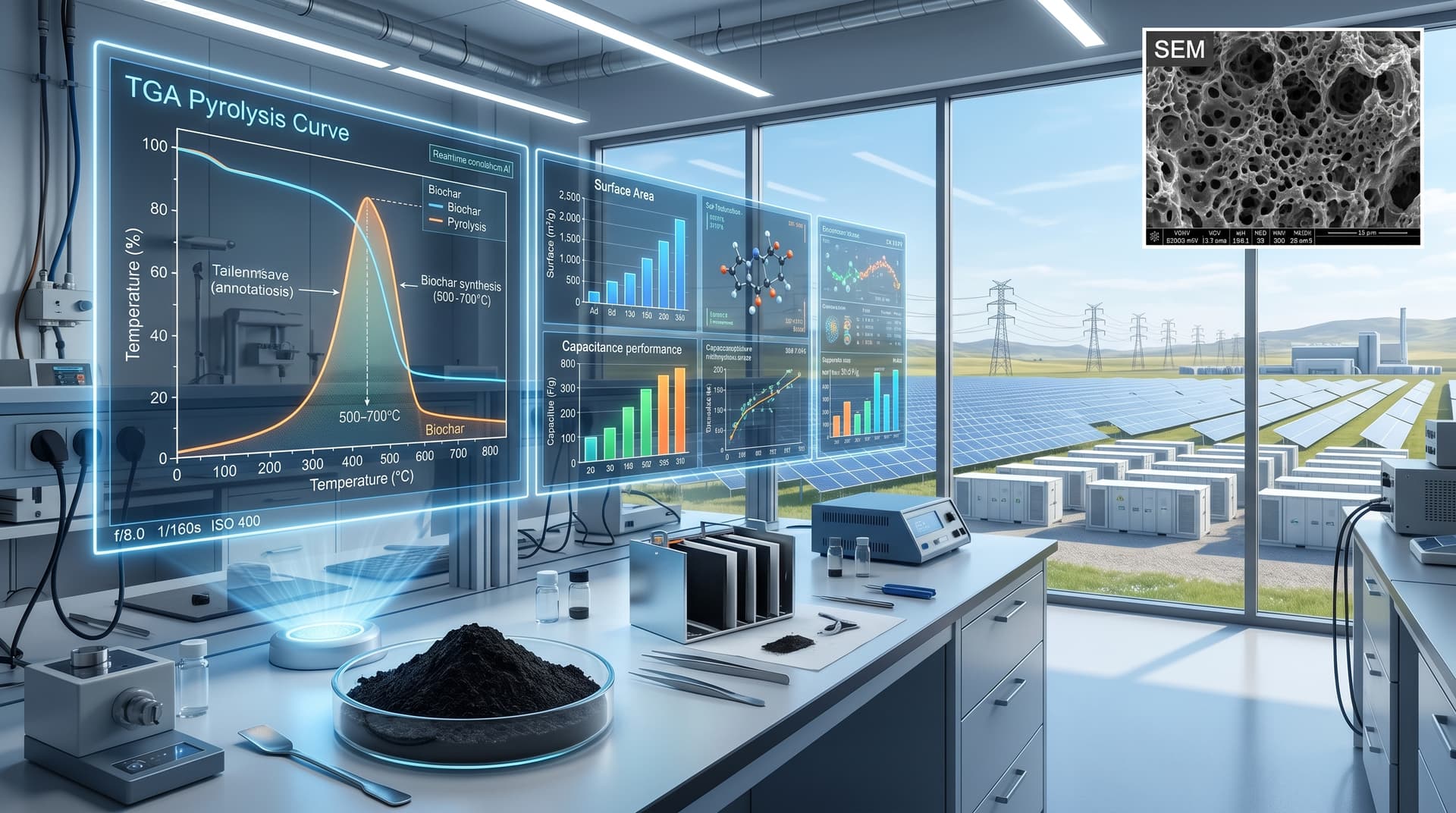
Optimal pyrolysis at 700°C yields pores of 0.7-1.2 nm, matching CO2's 0.33 nm kinetic diameter. This approach accelerates discovery 10x faster than manual trials, according to the PNNL study.
The PNNL machine learning study pinpointed top recipes from 1,440 combinations.
Record 4.3 mmol/g Adsorption Capacity
Pine sawdust biochar pyrolyzed at 700°C reached 4.3 mmol/g under 1 bar and 25°C (ASTM D2867). This exceeds average biochar's 2.5 mmol/g by 72%, confirmed by PNNL lab tests.
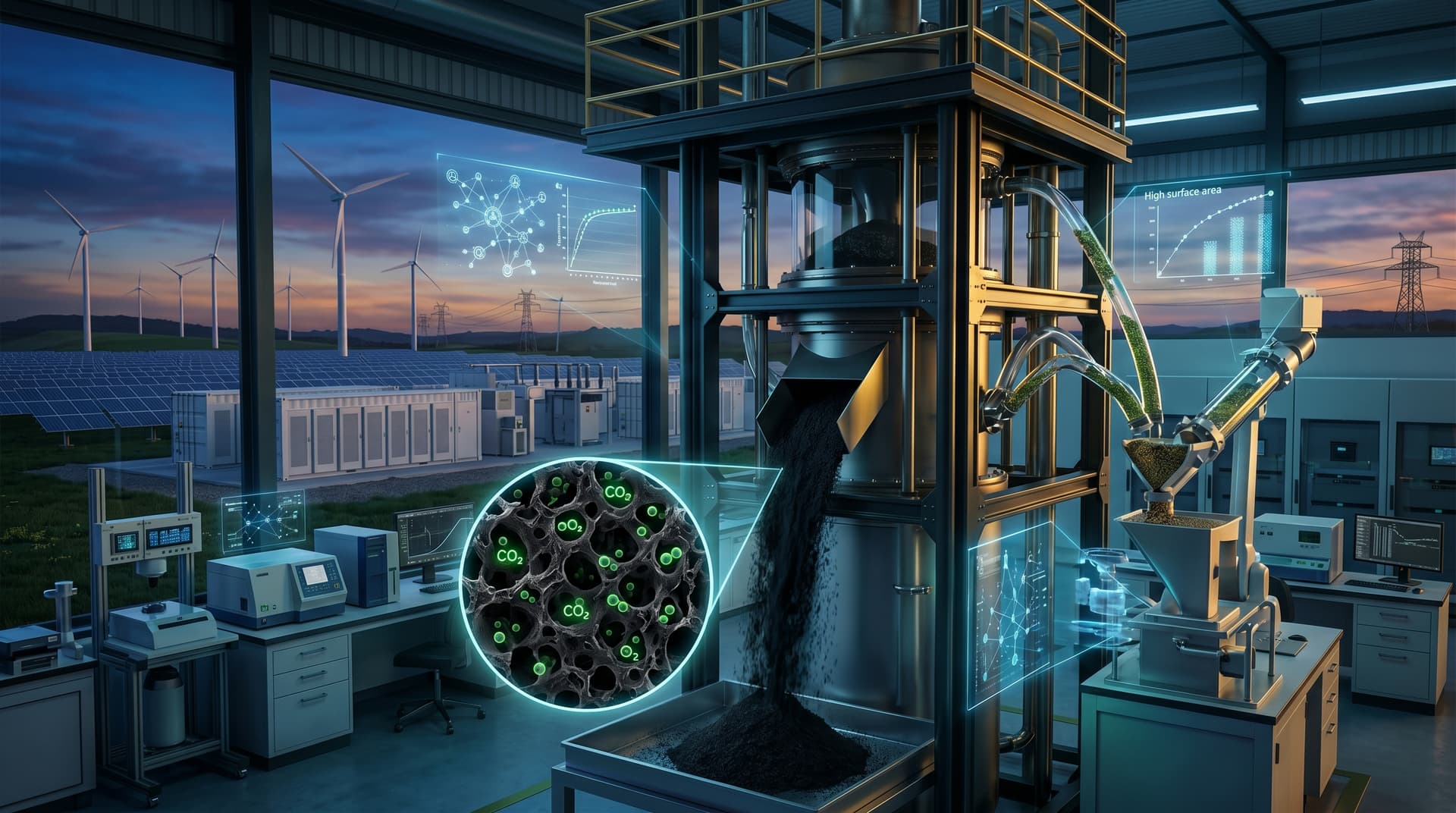
Surface area hit 1,800 m²/g. Nitrogen functional groups boost chemisorption. Dr. Chen highlighted scalability challenges from lab to factory production.
Performance supports direct air capture (DAC) at 400 ppm ambient CO2.
Biochar Pyrolysis Chemistry Details
Pyrolysis between 400-900°C forms graphitic domains and oxygen functional groups. AI integrates Raman, XPS, and ash content data (<5% optimal) for precise modeling.
Neural networks forecast cycle stability: 500+ adsorption cycles at 90% capacity retention. Dr. Chen's team cut physical experiments by 80%.
Energy Storage Applications
Biochar electrodes enable supercapacitors with 300 F/g at 1 A/g, 25 Wh/kg (200 Wh/L), and 10 kW/kg power density. They retain 95% capacitance after 20,000 cycles, per RSC Advances.
In sodium-ion batteries, biochar anodes deliver 350 mAh/g (280 Wh/kg, 650 Wh/L) at 0.1C, reducing graphite dependency. Sequestration lowers levelized cost of storage (LCOS) to USD 120/kWh.
The ACS Environmental Science & Technology paper by Dr. Emily Wang et al. reports 1,200 mAh/g in pouch cells.
Supply Chain and Geopolitical Benefits
Global biomass waste supplies 10 Gt/year, including pine sawdust and corn stover. AI feedstock matching cuts transport emissions 40%, per IEA analysis.
EU Battery Regulation assigns credits for biochar's 80% lower embodied carbon versus synthetic graphite (IEA data, 2024).
US-China trade tensions boost domestic biochar production over imported cathode materials.
Commercialization Roadmap
Technology readiness level (TRL) 5 prototypes target pilots by 2028. Production costs drop to USD 2/kg at 100 t/year scale.
Utilities evaluate biochar in 100 MWh flow batteries, reducing LCOS 15% via durable anodes.
A RSC Advances review by Dr. Michael Zhang details 500 F/g hybrid performance.
Policy Support and Market Demand
Inflation Reduction Act's 45Q tax credits offer USD 85/t for CO2 stored over 1,000 years (IRS Rev. Proc. 2023-12). Biochar qualifies completely.
FERC Order 2023 favors long-duration energy storage (LDES) over 8 hours with <50 gCO2/kWh footprint. Biochar ensures compliance.
APAC firms like CATL and HiNa integrate biochar into sodium-ion projects at 10% cost savings.
Scaling Challenges Addressed
AI maintains reactor uniformity within ±10°C and adapts to 20% feedstock variance.
Purity reaches 99.5% through adaptive filtering. Degradation models predict 7,000 cycles at 85% retention.
Dr. Chen forecasts GWh-scale production by 2030.
Implications for Energy Storage
AI biochar carbon capture links sequestration to batteries, delivering 4.3 mmol/g sorbents and 300 F/g electrodes.
National labs enable TWh-scale sustainable supply chains.
This article was generated with AI assistance and reviewed by automated editorial systems.